You open Safari to read an article, and the page loads clean: no banners, no video autoplay, no cookie popup. That is the job Wipr 2 does, quietly and in the background.
Stop ads and popups
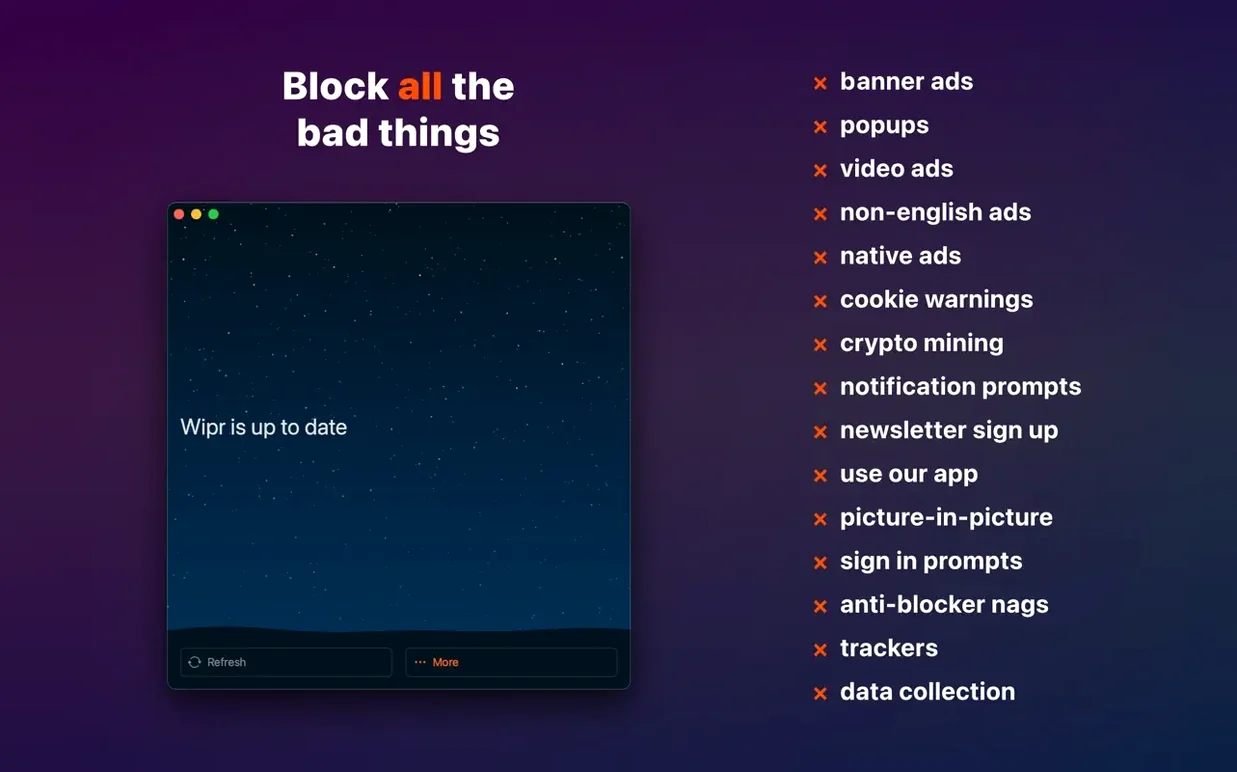
Wipr 2 blocks ads, popups, and other web annoyances on Safari. The 2.38 release adds Wipr Extra improvements across many websites, so more pages stay clean without extra configuration.
Cut off trackers
Trackers follow you across sites, building a profile of your browsing. Wipr 2 prevents them from loading, which helps keep that data private.
How Wipr 2 compares with similar Mac apps
Competing Safari content blockers tend to fall into two camps: free, basic extensions that block only the most common ad networks, and paid apps that offer rule-heavy filtering but require manual whitelisting for sites that break. Wipr 2 sits between them. It updates its blocking list twice a week, which is more frequent than most one-person open-source blockers manage, and covers trackers and cookie notices — two categories many free blockers skip entirely.
Another option is a browser-level blocker that replaces Safari's content blocking API with a local VPN profile. That approach catches ads in apps and other browsers, but it introduces a separate network configuration and sometimes interferes with Apple's own iCloud Private Relay. Wipr 2 stays inside Safari's native content blocking framework, which means it follows the same rules Apple applies to other extensions and does not require a network filter. The trade-off is Safari-only coverage.
A third type of blocker lets users write custom rules or import lists from the community. Wipr 2 does not expose its rule list for editing. The trade-off is simplicity: no lists to manage, no broken site debugging. For users who want to set it and forget it, that is the point.
Skipping the SIP step blocks Wipr Extra features
The most common setup issue is skipping the System Integrity Protection step. Wipr 2 needs SIP disabled for the Wipr Extra features to work on some sites. New users sometimes miss this because the app launches and seems to block ads even without SIP off — and it does, for basic blocking. But the Extra improvements named in the 2.38 release notes only activate when SIP is disabled.
Another mistake is assuming Wipr 2 works outside Safari. It is a Safari content blocker, not a system-wide ad filter. Email links opened in a different browser, embedded videos in apps, or in-app browsers inside other software will not be affected.
Some users also forget to enable the extension in Safari's settings after installing. The app itself can be launched, but the content blocking only starts after you go to Safari > Settings > Extensions and check the box for Wipr. The installer disk image includes a shortcut, but it is easy to skip that step when dragging to Applications.
What the 2.38 release changed in everyday use
Version 2.38, the current release, focuses on two areas. The Wipr Extra improvements affect a range of websites — this means fewer pages that previously required a manual reload or a whitelist exception now work out of the box. For daily browsing, the change is subtle: less time spent toggling the blocker off and on for a specific page that loaded incorrectly.
The accessibility improvements in 2.38 are harder to notice unless you use VoiceOver or other assistive technology. The blocker now interacts more cleanly with Safari's accessibility tree, which means screen readers are less likely to encounter leftover ad containers or hidden popup markup that the previous version did not strip completely.
Both changes are incremental. No new features, no redesigned interface — just refinement of the existing blocking rules. That matches the pattern of earlier Wipr 2 updates, where most releases tighten coverage on specific sites rather than add surface-level changes.
Wipr runs on every Mac from 2012 onward
Wipr 2 runs on macOS 10.13 or later and supports both Apple Silicon and Intel 64-bit Macs. That covers every Mac released since 2012 or so, including the transition models. The app is a universal binary, so you download one copy and it runs natively on either architecture without Rosetta.
Because it works through Safari's content blocking API, the app itself uses almost no CPU or memory while Safari is closed. When Safari is open, the blocker loads its rule list into the browser's extension system — the same way all Safari content blockers do. The actual blocking happens at the network level inside Safari, not in a separate process.
The disk image installs a single app file. No background daemons, no menu bar icon, no auto-updater that polls a server. Updates require downloading a new version and replacing the app manually.
For users on older Macs running macOS 10.13 through 10.15, the blocker will still receive the same rule list updates as on newer systems. The app's minimum requirement includes those versions, and the developer has not split the feature set by OS. The only difference in practice is that Wipr Extra features require SIP disabled, regardless of macOS version.
Cookie banners interrupt reading and often require a click just to dismiss. Wipr 2 removes these notices, letting you get to the content faster.
- Wipr Extra improvements on many websites.
- Accessibility improvements.
- macOS 14.0 or later
- Apple Silicon or Intel 64-bit Mac
- English interface
Install procedure
- Mount the downloaded disk image.
- Drag the app to the Applications folder alias.
- Launch the app from Launchpad after copying finishes.
- Disable SIP as required.
Reports from players
Sign in or create a tester account to file a report.
No reports filed yet.