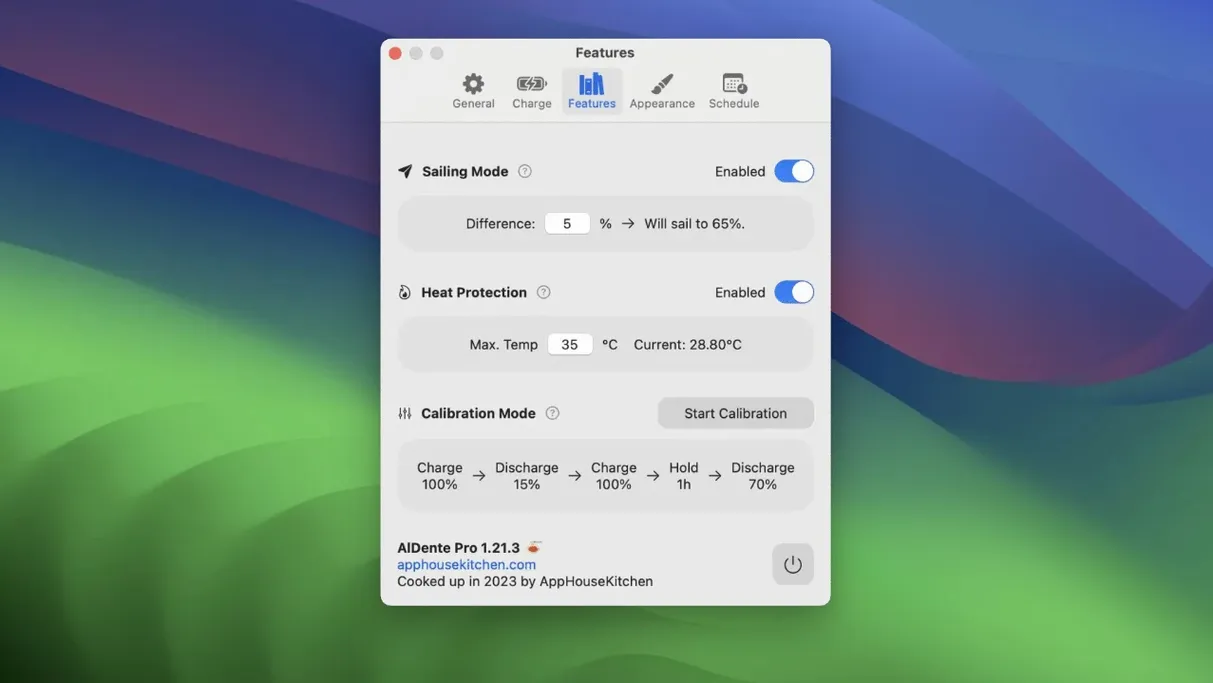
AlDente Pro runs on any Mac with macOS 12 Monterey or later, supporting both ARM and 64-bit Intel architectures. That covers most Macs from 2015 onward, so compatibility is rarely the sticking point. The question is what you want it to do once it's installed.
Check compatibility
Before downloading, confirm your macOS version in System Settings → General → Software Update. If you're on Monterey or newer, you're set. Older systems won't run it.
AlDente Pro gives a fixed limit you set and forget
Each has a different trade-off.
For users with irregular schedules, the learning phase sometimes never locks in. AlDente Pro gives you a fixed limit you set and forget, plus Sailing Mode and Calibration Mode on top of that.
It does not include heat protection or Sailing Mode.
Charge Limiter is a free, open-source alternative that sets a charge cap via a menu bar icon. It works well for the basic use case, but development has slowed. AlDente Pro's feature set is broader, and it receives regular updates — version 1.39.4 already fixes visual glitches spotted in early macOS 27.2 betas, which suggests active maintenance.
Real-world scenario: a freelancer who docks daily
A freelance video editor works from a home desk five days a week. The MacBook Pro stays plugged into a CalDigit dock from 9 AM to 6 PM, connected to an external monitor, keyboard, and storage drives.
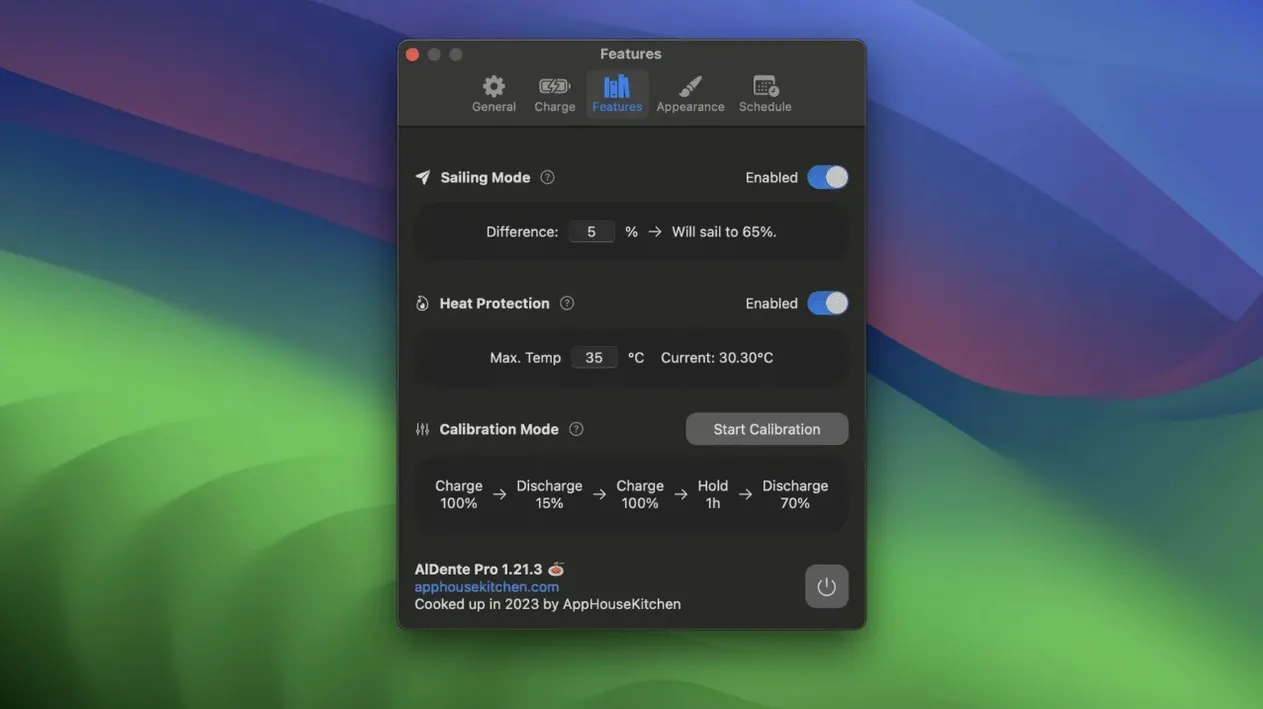
Heat protection kicks in when the CPU is under load during rendering; the app pauses charging if the temperature climbs above the threshold.
Overshoot by a percentage point on wake is normal and quickly corrected
In practice, the system's power management can briefly overshoot by a percentage point or two when the Mac wakes from sleep, especially on Intel models. AlDente Pro corrects it quickly, but the momentary overshoot is normal and not a sign it's malfunctioning.
Another common mistake is leaving Sailing Mode on while the Mac is docked for long periods. If you park the MacBook on a desk for days, you're better off setting a fixed limit instead. Sailing Mode works best when the laptop moves between plugged and unplugged states regularly.
A few users forget to grant AlDente Pro the necessary accessibility permissions on first launch. The app needs those permissions to control charging behavior at the system level. If the limit doesn't seem to take effect, checking System Settings → Privacy & Security → Accessibility is the first step. The same applies to automation permissions if you use the Calibration Mode scheduling feature.
Some beginners also ignore heat protection. The default heat protection settings are sensible, but some users let the threshold can be lowered if you live in a warm environment.
Set a charge limit based on how long you stay plugged in
After installing, open AlDente Pro and set a charge limit before anything else. The number depends on how long you stay plugged in — lower is better for longevity, but you also want enough range to work unplugged without hitting 0% too fast.
Heat protection should be turned on if it is off. Adjust it based on your environment, not the default.
Sailing Mode is useful but turn it off unless you move the Mac between plugged and unplugged locations. If you do, enable Sailing and set a lower threshold, from which point it starts discharging. Set it to 5% below your charge limit so it drains down to that level. Calibration Mode is for monthly maintenance — schedule it once every 30 days to run a full cycle. Do not turn it on permanently.
AlDente Pro takes priority over Apple's feature and works on Intel MacBooks
It does not. You can disable Apple's feature in System Settings before running AlDente Pro, or leave it on — AlDente Pro's limit will take priority.
Others ask whether it works with Intel MacBooks running macOS Monterey. It does. The app supports both ARM and 64-bit Intel architectures on macOS 12 and later. That means a 2019 MacBook Pro with an Intel Core i5 and a 2023 MacBook Air M2 both run the same version without issues. There is no separate "Intel-only build or a separate "Apple Silicon build" — it is a single .dmg file that detects the hardware.
The app itself uses negligible power — it is a menu bar utility with occasional background polling for temperature and charge state. It does not keep the CPU awake. That is by design, not a bug.
It sends software commands to the system's power management controller, the same way macOS itself does.
Finally, users often ask if they can uninstall it later without leaving leftover files. AlDente Pro does not install kernel extensions or system daemons. Removing it from the Applications folder and quitting it from the menu bar is enough. There is no configuration residue that affects normal charging.
Both are useful depending on how you use your MacBook.
- Fixed visual glitches in the Popover that occurred in the first betas of macOS 27.2.
- macOS 12 Monterey or later
- Apple Silicon or 64-bit Intel
Questions from the notes
Does AlDente Pro work on Intel Macs?
Yes, AlDente Pro supports both ARM and 64-bit Intel architectures, so it runs on Intel Macs as long as they run macOS 12 or later.
What macOS version do I need?
You need macOS 12 Monterey or later. Older macOS versions are not supported.
Install procedure
- Open the downloaded disk image.
- Drag the app into the Applications folder alias.
- After copying finishes, open the app from Launchpad.
Reports from players
Sign in or create a tester account to file a report.
No reports filed yet.