Small businesses often outgrow spreadsheets, but the switch to proper accounting software usually means losing the feel of the old workflow.
The tools that matter to an experienced user are here. The inventory module tracks products and services in real time, so stock levels stay current without manual reconciliation. Reports can project income and expenses 90 days out, which helps with cash-flow planning beyond just looking at historical numbers. Receipts upload and store inside the app, cutting down the paper trail.
Current version 23.1.9.R10 runs on both ARM and x86 64-bit Macs under macOS Monterey or later. Intuit provides release notes for the 2024 line, covering updates and improvements as they land. For this release, R10 adds a Backup Save As option and company-specific backup locations—small changes, but useful if you manage multiple sets of books or prefer manual control over where backups go.
Backup saves simplified with a straightforward choice
The R10 release stayed focused on the backup side of things. For day-to-day work, the Backup Save As option gives you a straightforward choice when you hit the backup command: save to the default location or pick somewhere else on the fly. That sounds minor until you are mid-month and want to archive a copy to an external drive without changing the permanent backup path in settings. Company-specific backup locations work the same way — if you handle books for more than one business, each company file can now have its own destination. No more sorting through a single folder of mixed backups to find the right one.
The rest of the application works as it did before. Invoice creation, expense tracking, bank feeds, and payroll all behave the same way. Intuit’s release notes for the 2024 line cover general updates and improvements across the suite, so not every change is visible from the surface. The core workflow — enter data, run reports, reconcile accounts — remains unchanged.
Installs from a disk image and works with local files
QuickBooks Mac Plus is a desktop application, not a lightweight browser tool. It installs from a disk image, copies into Applications, and then works with local company files. It needs macOS 12 Monterey or later, and it runs on both ARM and x86 64-bit Macs, so an Intel Mac from 2020 and an Apple Silicon Mac from 2023 both work without translation layers. The application is English-only throughout — dialogs, help files, and reporting are all in English.
No activation is required. You open the disk image, drag the app to the Applications folder alias, and launch it from Launchpad. The dashboard populates as soon as you open or create a company file. It shows income, expenses, paid invoices, and other activity in one view. Reports draw from the same data and can project income and expenses for the next 90 days, which is useful for forecasting without exporting to a separate tool.
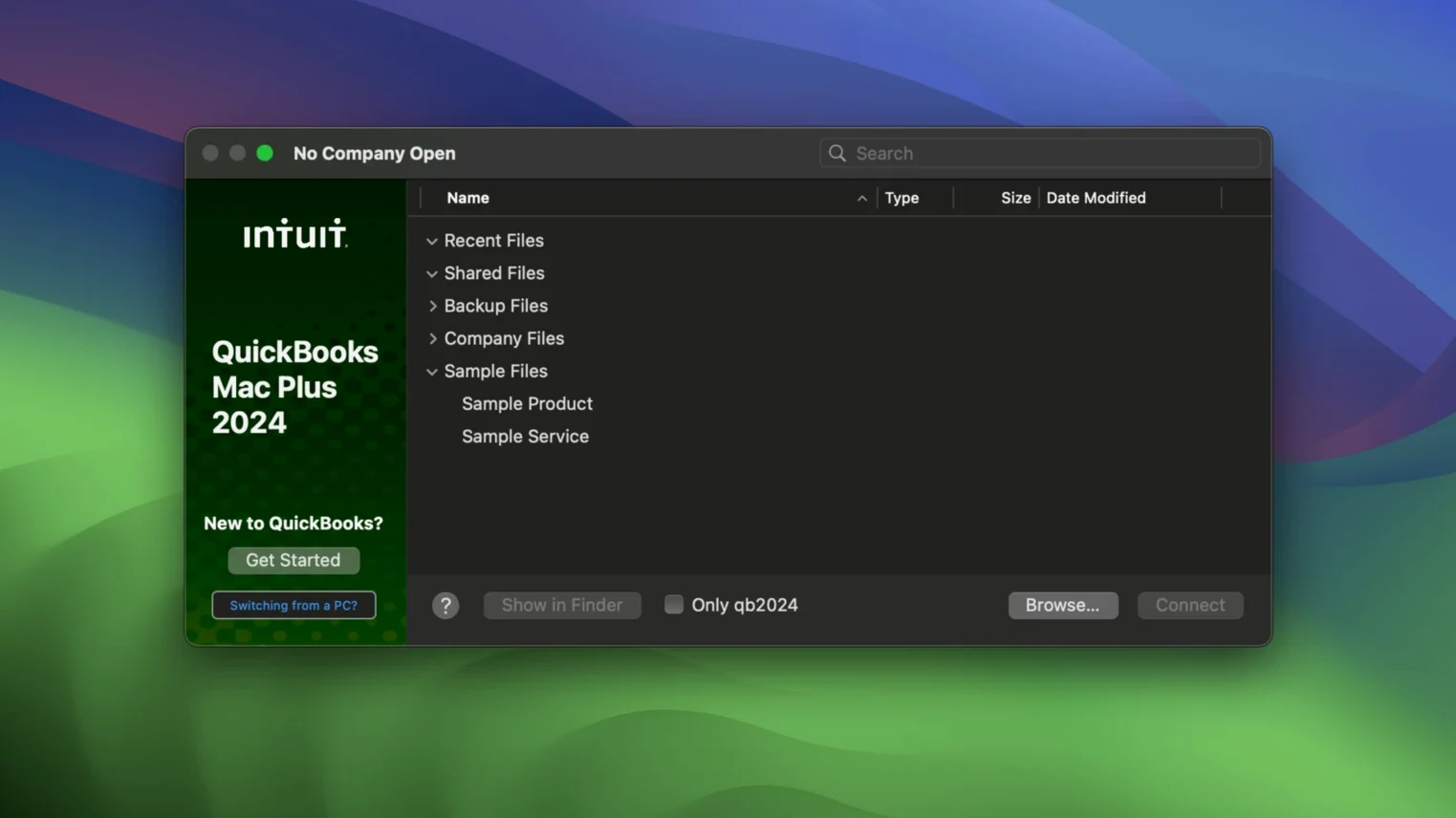
The app handles company files, which means you work on a local copy of your books. This is the same model QuickBooks desktop users have relied on for years. There is no cloud sync built in, so backups — now with the R10 improvements — are your responsibility.
Adjust the chart of accounts before entering your first invoice
Before entering your first invoice or connecting a bank account, set up the company file properly. Default categories may not match your business structure. Adjust the chart of accounts early so that reports reflect your actual income and expense categories from day one.
If you plan to use inventory tracking, enter products and services as items in the inventory module before recording any transactions. The tool tracks quantities in real time, but it needs the list populated first. Without items, the inventory data stays empty and the reports cannot show stock levels.
Backup settings are worth checking before you run the first close of a period. With the R10 update, you can set company-specific backup locations in the preferences. Decide whether you want backups to go to the default folder, an external drive, or a network share, then configure that before you accumulate data. Changing it later works, but the first automatic backup may land in the default location if you haven’t set it.
Bank account connection requires your bank’s support for direct feeds. Not all Canadian or US banks provide them for desktop applications. If the connection fails, manual bank statement import is the fallback. Set up the accounts manually first, then attempt the connection — it avoids duplicate entries if the feed starts pulling transactions after you have entered opening balances.
Best for single-Mac bookkeepers handling a few clients
QuickBooks Mac Plus fits best for small businesses that keep their books on a single Mac and do not need multi-user access or cloud collaboration. If you are a bookkeeper handling two or three small clients and each client has their own company file, the company-specific backup locations in R10 make that workflow cleaner. One folder per client, one backup schedule per file.
Businesses that rely on inventory tracking benefit from the real-time item tracking. No switching between apps.
The English-only interface means it is suited for users comfortable with financial terminology in English. QuickBooks Mac Plus is a locally installed desktop version for users who prefer offline file storage and no online activation.
If your workflow involves importing from Excel or Xero tables, the import tool handles that directly. You can bring in lists of customers, vendors, chart of accounts, and opening balances without re-entering everything by hand. That alone saves time for anyone switching from spreadsheet-based bookkeeping.
You can track inventory, project income, and keep receipts in one place, and the backup tweaks make routine maintenance a little safer.
- R10 adds a Backup Save As option for manual backups.
- R10 adds company-specific backup locations.
- macOS 12 Monterey or later
- Apple Silicon or Intel (x86 64-bit)
Questions from the notes
Can QuickBooks Mac Plus import data from other accounting tools?
Yes, it supports importing data from Excel and Xero tables, which makes moving from spreadsheets or another accounting package easier.
Does QuickBooks Mac Plus work on Apple Silicon Macs?
Yes, the app supports both ARM and x86 64-bit architectures, so it runs on Apple Silicon and Intel Macs.
Install procedure
- Open the downloaded disk image.
- Drag the app to the Applications folder alias.
- After copying finishes, launch the app from Launchpad.
Reports from players
Sign in or create a tester account to file a report.
No reports filed yet.