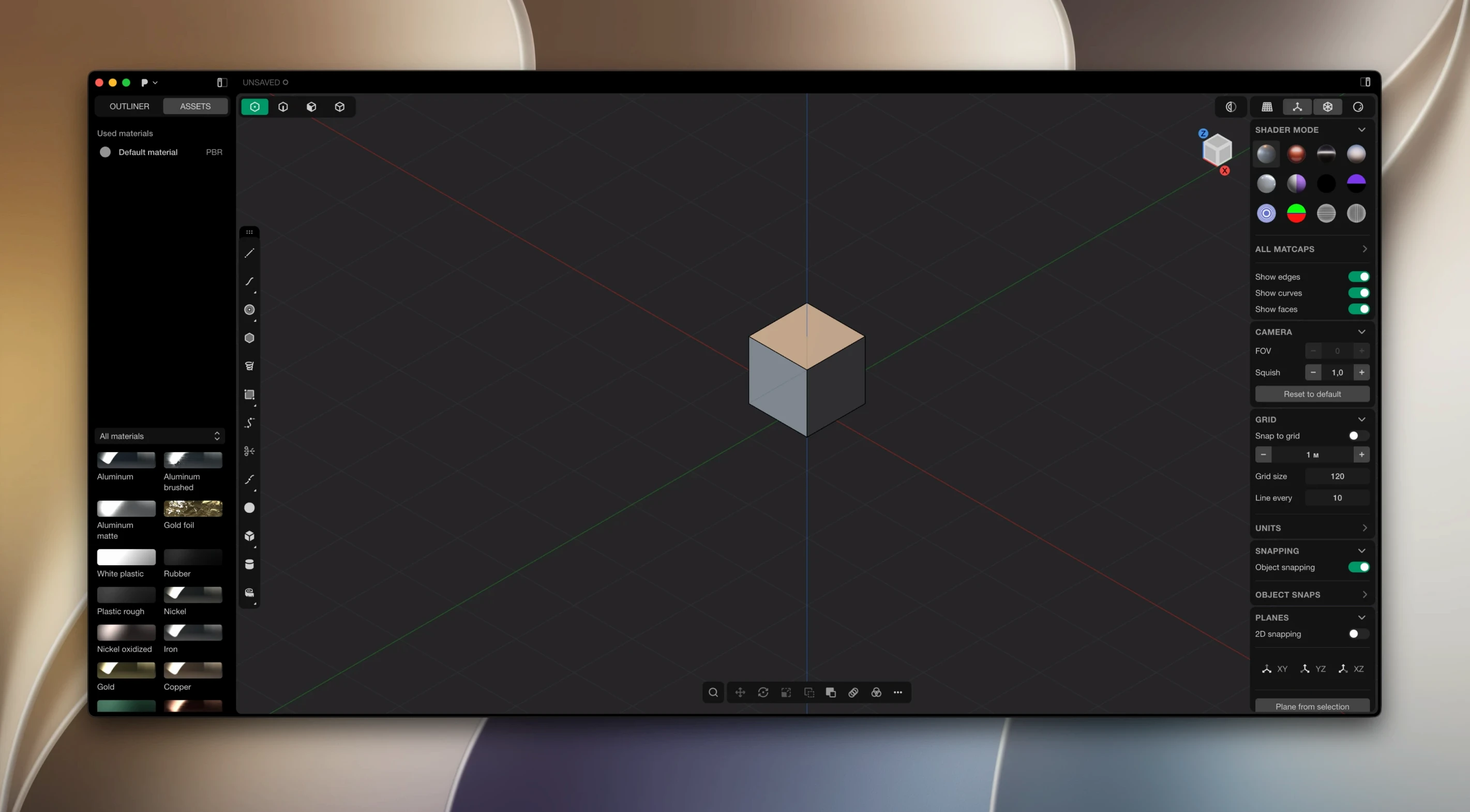
Plasticity 26.1.3 supports live dimensions that update geometry as you type, and XNURBS surface blending for G2-continuous surfaces. It is professional 3D modeling software for solids and surfaces, aimed at artists and designers who want CAD-style precision without the traditional CAD overhead.
| Detail | Info |
|---|---|
| Version | 26.1.3 |
| Developer | Nick Kallen |
| Category | Apps |
| macOS | 12 and later |
| Architecture | Apple Silicon |
| Languages | English, Russian, German, Spanish, Italian, Traditional Chinese, Simplified Chinese, Japanese |
Updates are not automatic; you download and install each new version manually. The Studio tier, aimed at advanced surface modeling and commercial production, adds PolySplines conversion and expanded CAD translation. For most users, the core modeling workflow stays the same: direct manipulation, live dimensions, and a clean interface that respects your existing modeling habits.
Working alongside other tools on your Mac
Plasticity does not try to replace your whole pipeline. It sits between concepting and final production. You can model a part or a surface in Plasticity, then move it into rendering, animation, or CAD packages for the next step. The Export Hidden Line feature in 26.1.3 is a good example: it produces technical SVG output that you can bring into vector editors, documentation tools, or a CNC workflow. That keeps Plasticity useful even when the final deliverable is not a 3D file.
Because the app is Apple Silicon native, it behaves like any other modern Mac application. It appears in the Dock, responds to standard macOS window management, and works with the usual copy-paste and file-open conventions. You can keep a reference image open in a separate window and model alongside it, or switch between Plasticity and your browser for documentation without fighting the system.
What the Mac version asks of you
The requirements are modest: macOS 10.14 or later and an Apple Silicon Mac. There is no Intel support in this build, so if you are on an older Intel machine, this particular version will not run. On a supported Mac, the app is self-contained. You download the package, move the app to your Applications folder, and launch it. The install and activation instructions come inside the package, so you do not need to hunt for separate documentation.
Language support is broad. The interface covers English, Russian, German, Spanish, Italian, Traditional Chinese, Simplified Chinese, and Japanese. If you work in a team with mixed language preferences, each user can set the interface to their own language without affecting anyone else.
Move the Patcher folder to the desktop to clear activation issues
A few issues show up regularly. Most have straightforward fixes.
- Patch or activation problems. If the patcher does not seem to take effect, move the Patcher folder to the desktop and run it from there. Some macOS permissions interfere with executables inside nested folders. Running it from a plain location usually resolves it.
- Manual updates. Since updates are not automatic, it is easy to fall behind. Check the version number you have against the current release. When a new version appears, download it and install it the same way you did the first time. Your settings and files carry over; there is no migration step.
- Apple Silicon only. This build does not run on Intel Macs, so do not try to force it with translation layers or compatibility settings. If you are on an Intel machine, you need a different build or a different machine.
- File exchange with other CAD tools. If you are moving models between Plasticity and another package, check the export format before you spend time on a complex model. The Studio tier adds expanded CAD translation, so if your workflow depends on specific formats, that is the tier to look at.
From morning sketch to afternoon solid model with live dimensions
Consider an industrial designer who sketches a consumer product enclosure in the morning, then needs a solid model for a client review by the afternoon. In Plasticity, they start with a simple block and pull faces directly. The live dimensions mean they can type in the exact wall thickness and watch the geometry snap to the value. For the curved handle, XNURBS surface blending gives them a smooth G2 transition between two surfaces without rebuilding the whole shape.
When the client asks for a change, there is no history stack to rewind. The designer just grabs the face and moves it. The boolean operations stay watertight, so the model remains solid even after cutting holes or joining parts. If the client needs a technical drawing, the Export Hidden Line feature produces an SVG they can drop into a presentation deck.
That workflow is the point of Plasticity. It is not a full CAD suite and it does not pretend to be one. It is a focused tool for getting from a shape in your head to a solid model that other tools and people can use.
- macOS 10.14 or later
- Apple Silicon
Questions from the notes
Does Plasticity update automatically?
No. According to its documentation, updates must be downloaded and installed manually.
What is Plasticity Studio?
Plasticity Studio is intended for advanced surface modeling, PolySplines conversion, expanded CAD translation, and commercial production work.
Which macOS versions are supported?
Plasticity 26.1.3 runs on macOS 12 and later, on Apple Silicon Macs.
Install procedure
- Install and activation instructions are included in the package.
- If patch issues occur, move the Patcher folder to the desktop.
Reports from players
Sign in or create a tester account to file a report.
No reports filed yet.