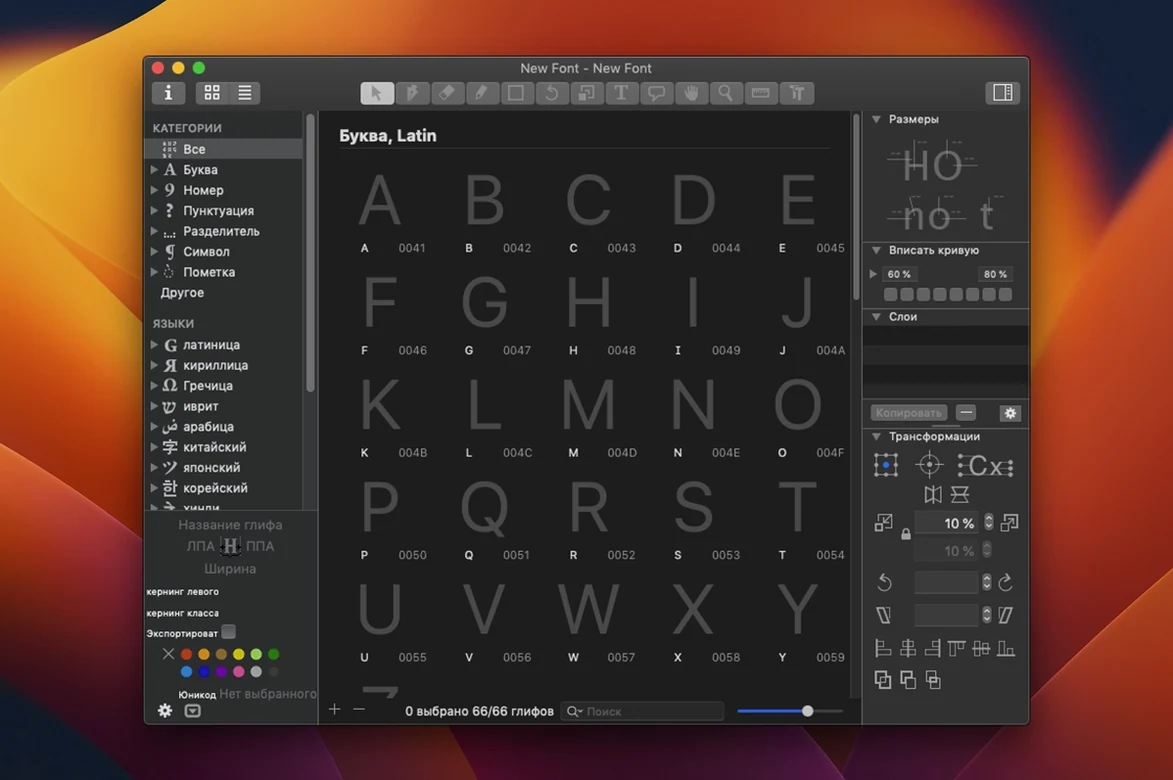
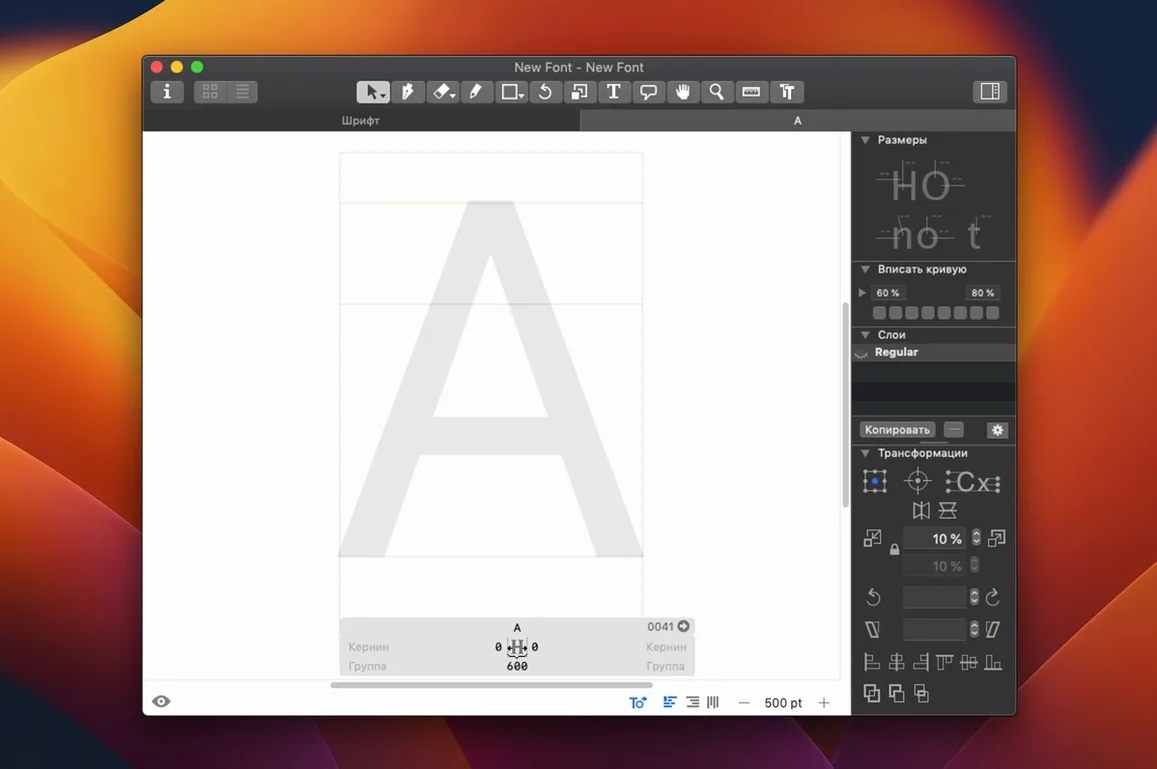
If you have used vector drawing tools like Illustrator or Inkscape, Glyphs will feel familiar—but it's built specifically for type design. The workspace is clean, with only the interface elements you need for the task at hand. As a professional font editor, it lets you create and edit OpenType fonts with precision.
Pen Tool Snaps to Curves and Handles
Start by drawing a simple glyph. The pen tool snaps to curves and handles, making it easy to get consistent outlines. Use the contextual menu for quick text editing—right-click on a glyph to access options without breaking your flow. The app integrates with macOS and your workflow tools, so you can drag and drop fonts into other apps or use the system font picker to test your work.
Previewing Your Work
Glyphs Viewer is a companion app that lets you preview fonts while you work. It's useful for checking spacing and kerning in a real text layout. When you're ready, export the font and test it in a document. Glyphs requires macOS 12 or later and runs on both Apple Silicon and Intel Macs.
Set Up a Project Folder and Import a Font
Once Glyphs is on your machine, take a few minutes to set up a project folder and import a font you want to modify. The app doesn't come with sample fonts, so either open an existing OpenType file or start a new project from the File menu. Draw a few basic letters first—A, B, C—to get a feel for the pen tool and curve handles. Save early. Glyphs uses a native .glyphs project file format, but it can also open and save TTF and OTF files for editing.
Learn the Interface Languages
Glyphs supports 13 interface languages including Russian, Simplified Chinese, Turkish, and Japanese. If English isn't your first language, switch it in Preferences on day one. The UI is sparse enough that you won't get lost, but having menus in your language helps when you're learning terms like "ligature" or "kerning pair."
Test Your First Export
Export a single glyph as PNG or SVG to see how the app handles vector output. Then export the full font as PDF or SFSymbols. Check the output in a text editor or a document to confirm spacing and outlines. This confirms that your workflow from Glyphs to the rest of macOS is working.
The Only Font Editor Built Specifically for macOS
Glyphs isn't the only font editor on macOS, but it's the only one built specifically for the platform. Here is how it stacks up against two other options.
FontLab
FontLab is a multi-platform font editor available for Windows, Mac, and Linux. It has a steeper learning curve because its interface packs more panels and tools than Glyphs. FontLab supports variable font formats and advanced scripting, but its Mac version feels like a port from another OS. Glyphs, by contrast, works like a native Mac app—keyboard shortcuts, trackpad gestures, and macOS window management all behave as expected. If you work only on Mac and prefer a focused tool, Glyphs is the simpler choice.
BirdFont
BirdFont is a free, open-source font editor that runs on macOS, but development has slowed. Its interface is less polished, and it lacks some of the OpenType feature editing that Glyphs handles natively. BirdFont can export basic TTF files, but it doesn't support SFSymbols or the same level of script-driven automation. For serious type design, Glyphs offers a more complete feature set without the extra clutter of toolbars you won't use.
RoboFont
RoboFont is a Python-based font editor aimed at scripters. Its main interface is a simple drawing window, but most of the heavy lifting happens through Python scripts. RoboFont is powerful for automating glyph generation, but it expects you to write code. Glyphs includes a scripting interface too, but you can also work entirely through the GUI. If you prefer pointing and clicking over writing scripts, Glyphs is the better fit.
Drag a .glyphs File Straight into the Font Picker
Glyphs integrates with the operating system in ways that save time. Drag a .glyphs file from Finder straight into the font picker in a word processor—it registers temporarily so you can test live text. Export a family of fonts, install them via double-click, and they appear in any app that uses the system font menu.
The companion app Glyphs Viewer runs alongside the main program. When you adjust spacing or design a new character in Glyphs, Viewer updates live. You can leave Viewer on a second monitor or in a split-screen view while you edit.
For scripters, Glyphs supports Python-based scripts and a plugin interface. Write a script that generates a full set of alternate glyphs, then run it from the Script menu. The app also integrates with macOS notifications—export completes, and a system alert appears. No third-party tools needed for basic automation.
If you use version control like git for your font projects, the .glyphs file format is plain text. You can track changes, diff glyphs, and revert edits without losing your work. This is rare among font editors, which typically save in binary formats.
Handles CJK Fonts with Thousands of Glyphs
People often ask whether Glyphs can handle fonts for East Asian languages. Yes—it supports Traditional and Simplified Chinese, Korean, and Japanese in its interface, and it can edit fonts that contain thousands of CJK glyphs. The character grid view lets you navigate large sets without scrolling through a list.
Another question is whether you need design experience to use it. Glyphs is a professional tool, so some understanding of vector drawing and typography terms helps. If you already use Illustrator or Affinity Designer, the pen tool and curve editing will feel familiar. The app includes tooltips and a clean layout, but it assumes you know what a baseline, ascender, and kerning pair are.
People also wonder if Glyphs can open fonts from other editors. It opens TTF, OTF, and UFO formats, so you can edit fonts started in FontLab or BirdFont. It saves back to OTF and TTF, but for maximum compatibility with future editing, stick with the .glyphs project file.
Finally, some ask about the glyphs 3 crack mac or glyphs crack mac — but the current version 4.1.1 runs on macOS 12 and later without any activation step. No serial code, no license file. You install the disk image, drag the app to Applications, and launch it from Launchpad. That's it.
- Build 4.1.1 (4108) with release notes dated 2026-09-12.
- macOS 12 or later
- Apple Silicon or Intel
Install procedure
- Open the downloaded disk image.
- Drag the app to the Applications folder alias.
- Launch the app from Launchpad after copying finishes.
Reports from players
Sign in or create a tester account to file a report.
No reports filed yet.