
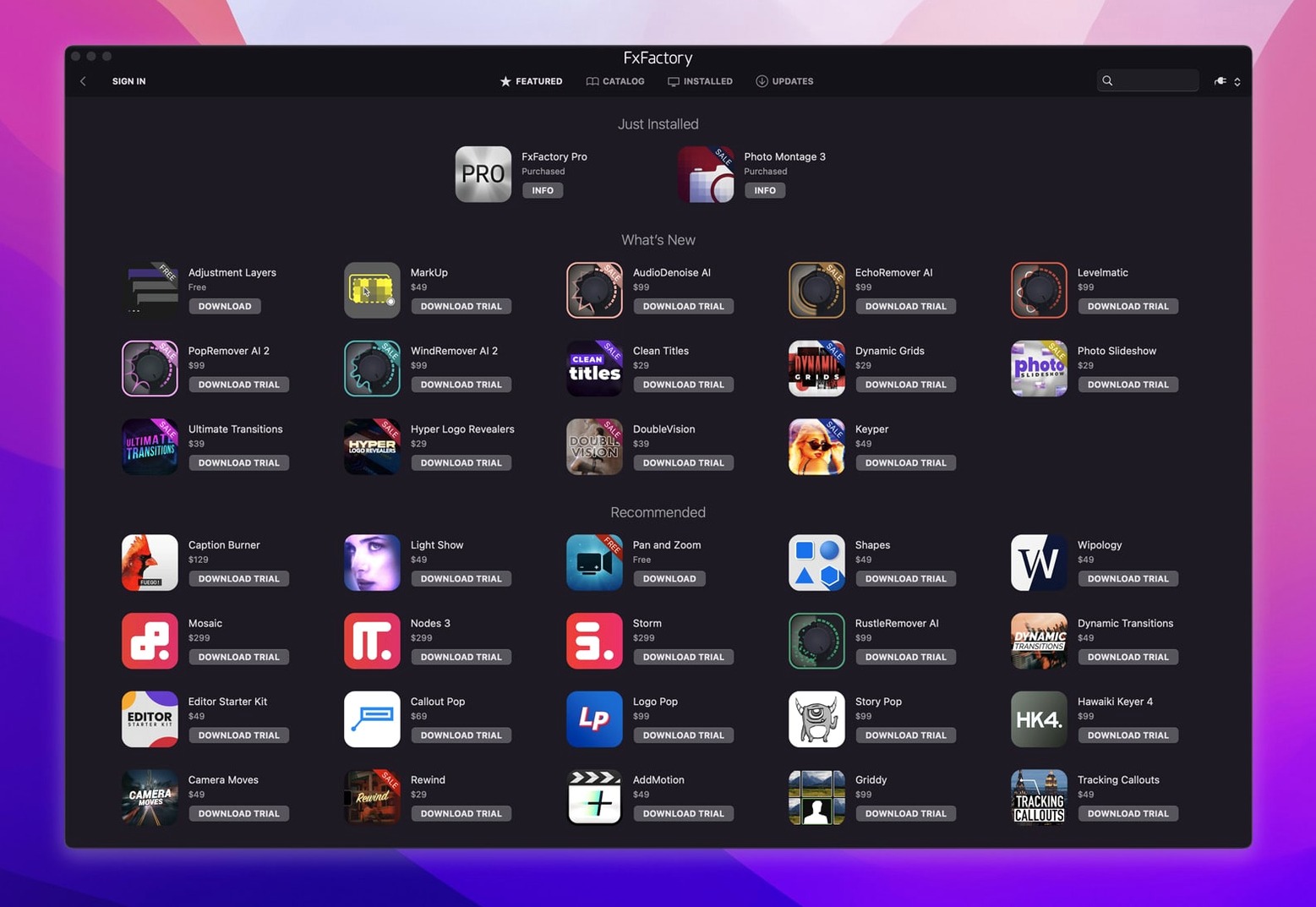
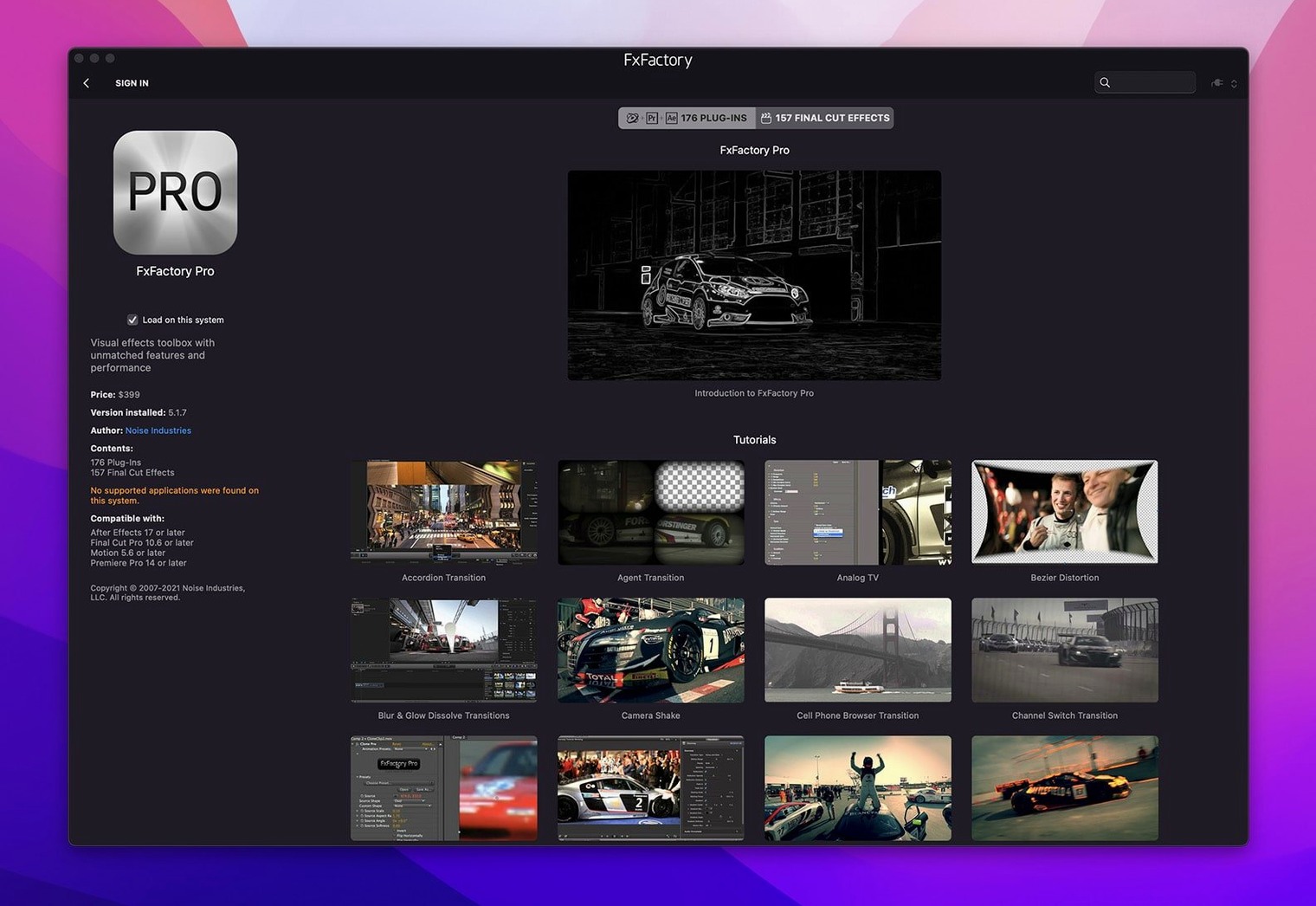
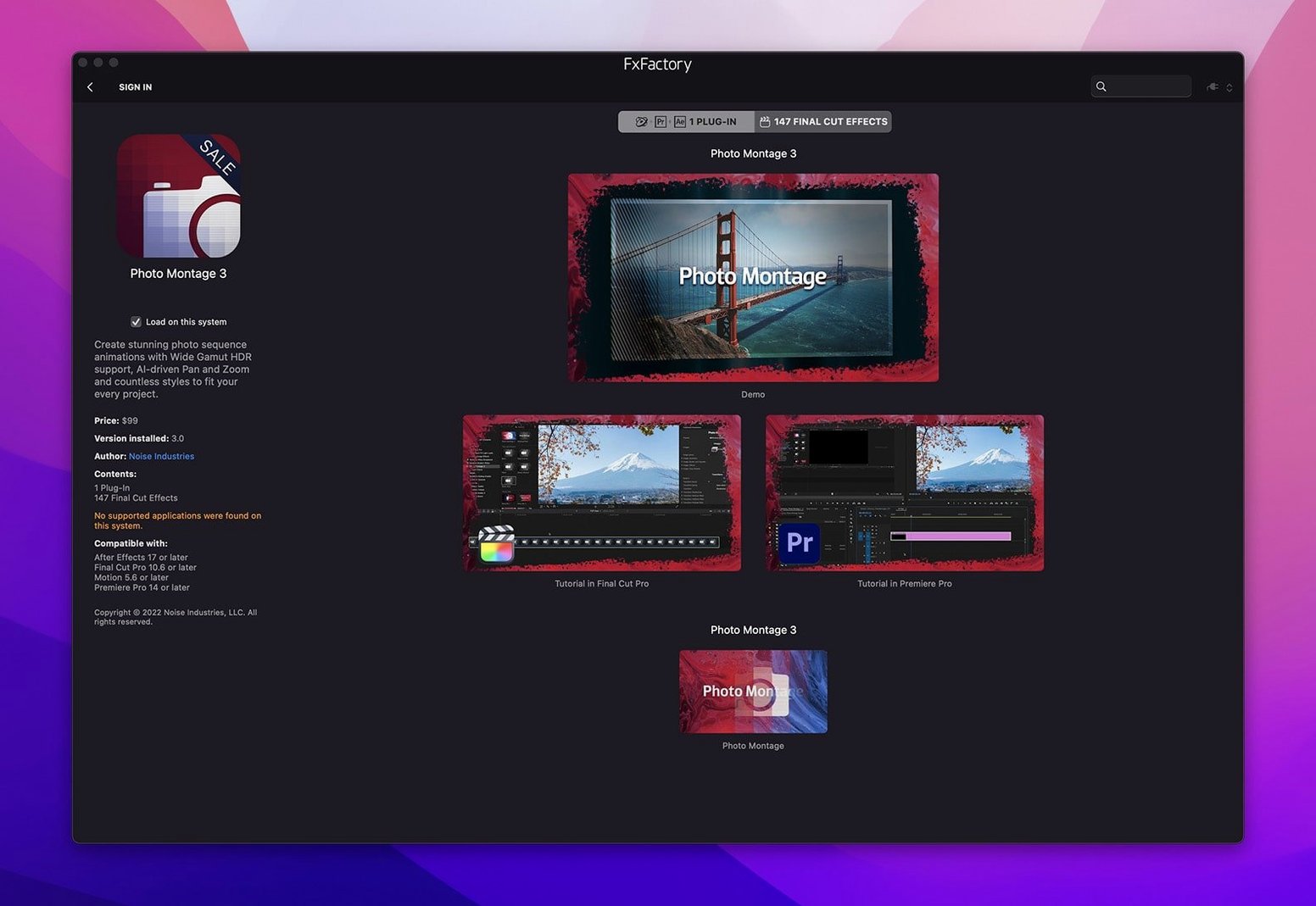
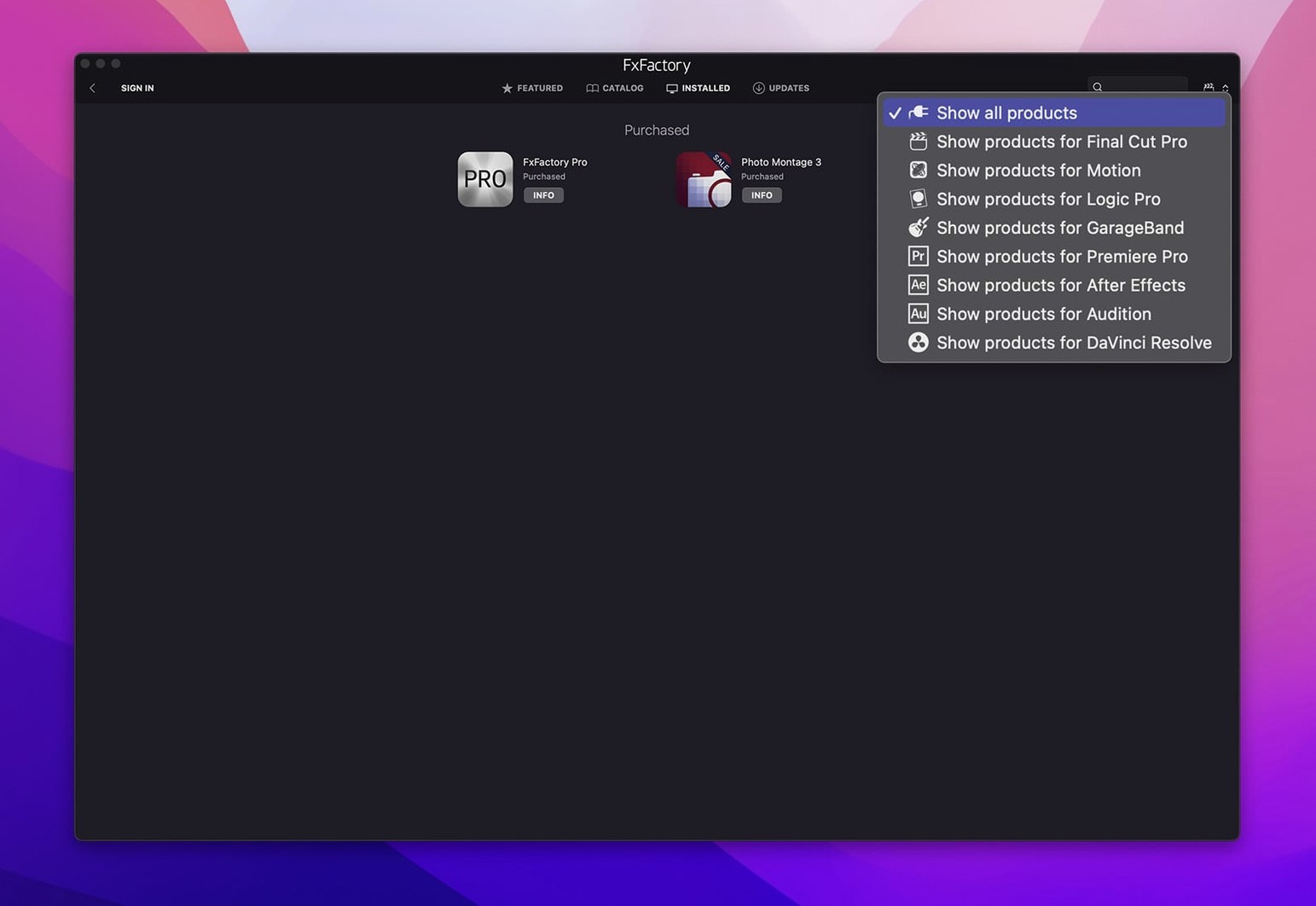
FxFactory solves the problem of scattered effects plugins across your editing suite. Instead of hunting through separate installers and license managers, it gives you one interface to install, organize, and apply visual effects across Final Cut Pro, Motion, Premiere, After Effects, and DaVinci Resolve. As a plugin manager, it keeps track of what's on your system, so you know exactly what's available in each host.
The Pro Pack raises the ceiling on what those plugins can do. Effects run at 16-bit and 32-bit motion graphics processing, which matters when you're pushing gradients, glows, or color work in high bit-depth projects. The current version, 9.0.5-8654, installs on both Apple Silicon and Intel Macs without requiring SIP to be disabled—a clean setup for a system you'd rather leave locked down. The English interface is straightforward: browse the catalog, install what you need, and tweak parameters directly in your host application.
Add a color wash text reveal without building from scratch
Open Final Cut Pro or After Effects. You have a timeline with a few clips and you want to add a text reveal that fades through a color wash. Instead of building it from scratch or hunting for a separate effect file, you launch the fxfactory manager from your dock or the host application's plugin menu. The manager opens to a grid of installed effects—each one has a thumbnail, a category tag, and a small gear icon for settings.
You type "text" into the search bar inside the manager. The list narrows to about eight text-related effects. You double‑click one called "Chromatic Drift Title." The effect appears in the preview window inside the manager, where you can scrub through a short animation. You adjust the drift amount and the color shift sliders until the preview looks right. Then you drag the effect from the manager directly onto the clip in the timeline. The effect's parameters appear in the host's normal effect panel—no extra pop‑ups, no second interface to learn.
You play through the timeline once. The effect renders in real time. That's it. The effect is part of the project now, and it stays there even if you close fxfactory and reopen the project tomorrow.
Later, you want to apply the same effect to a second clip. You open fxfactory, click the effect once, and choose "Duplicate." A copy of the effect with the same settings appears in your project's effects bin. You drag it onto the second clip. No need to re‑adjust the parameters unless you want a different look.
For a final export, you render the timeline as usual. The effect is processed within the host's native rendering pipeline—no extra export step, no intermediate files. The result is a single movie file with the effect baked in.
Fix when FxFactory doesn't see installed effects
The most frequent issue people hit is fxfactory not seeing the installed effects. This usually happens because the manager is looking at a different plugin folder than the one the installer wrote to. Open the fxfactory preferences panel (it's in the gear menu at the top‑right of the manager window) and check the "Plugin Path" setting. Make sure it points to the folder where the host application expects plugins. For Final Cut Pro, that's typically ~/Library/Application Support/FxFactory/Plugins. For After Effects, it's inside the common plug‑ins folder for the Adobe suite. If the path is wrong, click the folder icon and browse to the correct location.
Another snag: effects appear in the manager but don't load in the host. Often the cause is a permission issue. The installer might have written the effects to a system‑protected folder, and the host application doesn't have read rights. A quick fix is to copy the entire FxFactory folder from /Library/Application Support/ to ~/Library/Application Support/ (your user's Application Support folder). That way the effects live under your user account, and permissions are rarely a problem.
If an effect crashes the host when you try to apply it, the effect might be a 32‑bit effect running on a project that's set to 8‑bit color. Check the host's project settings and raise the color depth to 16‑bit or 32‑bit float. The Pro Pack effects are designed for higher bit depths, and they can misbehave when forced into an 8‑bit pipeline. If you're working in an 8‑bit project, look for effects labeled "8‑bit compatible" in the manager's description panel.
Finally, sometimes the manager won't open at all after a macOS update. That's a known issue with any plugin that uses FxPlug. The fix is to re‑run the fxfactory installer from the included setup file. It re‑registers the plugin paths without overwriting your installed effects or settings.
Better than Boris FX, Red Giant, or free shader plugins
There are a few other ways to get visual effects onto a Mac editing workflow without writing code. The three closest parallels are Boris FX, Red Giant's Universe, and the free ShaderToy‑style plugins that come with some NLEs.
Boris FX is a heavy‑duty effects suite that integrates with Final Cut Pro and After Effects. It offers a larger library of pre‑built effects, especially for titling and compositing. However, Boris FX uses its own proprietary engine for rendering, which means you have to export your timeline through its separate renderer to get the final output. FxFactory hands the effect back to the host's native render pipeline, so you export exactly as you normally would. For a workflow where you just need one or two effects per project, the FxFactory approach is faster because you never leave the timeline.
Its library is broader than FxFactory's, and it includes tools like Chromatic Aberration and LUTs. But Universe requires the Red Giant Application Manager to install and update—a separate piece of software that sits alongside the host. FxFactory serves as its own manager, so there's one less application to keep updated. For a user who wants a single management interface, FxFactory's all‑in‑one approach is cleaner.
Built‑in NLE effects (the ShaderToy or stock effects in DaVinci Resolve's Fusion tab) are free and require no installation. They're fine for basic operations like blurs or color shifts. But they lack the parameter depth of a dedicated plugin. FxFactory effects come with exposed sliders for things like drift speed, color shift amount, and animation curves—parameters that the built‑in effects either hide or don't offer at all. For a motion graphics artist who needs precise control over an effect's behavior, the investment in a plugin manager pays off.
Consistent lower-thirds and glows from a single library
You edit internal training videos for a mid‑sized company. The projects are short—three to five minutes—and need a consistent look: a lower‑third name plate, a subtle glow behind the speaker, and a clean transition between sections. You have a library of about twenty FxFactory effects you've set up once and reuse. Each new project starts by copying the template project file from the previous one, which already has the effects applied. You open the new footage, replace the clips, and the effects carry over. The parameters are already dialed in from the last project. You tweak the glow intensity if the background color changed, and you're done. The whole process takes twenty minutes instead of forty if you were building those effects from scratch each time.
The key advantage here is repeatability. Once you've set up an effect's parameters in FxFactory, you can export those settings as a preset file and import them into any other project. For a corporate video editor who works with the same few templates week after week, that consistency saves hours over the month.
Best for Motion graphics artists using 16‑bit and 32‑bit processing
Motion graphics artists who work in After Effects or DaVinci Resolve get the most from the Pro Pack's 16‑bit and 32‑bit processing. If your projects involve gradients, color washes, or animated text overlays that need to look smooth on a high‑DPI display, the higher bit depth matters. You'll see banding in gradients disappear compared with running the same effect in 8‑bit mode.
Video editors who switch between hosts—for example, cutting in Final Cut Pro but doing color work in DaVinci Resolve—benefit from having one plugin manager that spans both applications. You install an effect once in FxFactory, and it's available in both hosts. That's more efficient than installing separate Boris FX or Red Giant packages for each host, which often require separate licenses and update schedules.
Plugin designers and tinkerers can use FxFactory to test their own effects without writing a full plugin from scratch. The manager's built‑in interface for browsing and applying effects means you can prototype a look and see it instantly in your timeline, then adjust parameters on the fly. For a designer who builds custom transitions or titles for a client, the ability to iterate quickly inside the host application is a genuine time‑saver.
Editors on older or lower‑end Macs (Intel Macs with integrated graphics, for instance) appreciate that FxFactory doesn't require a separate rendering engine. Because effects run inside the host's native pipeline, you don't need extra GPU resources to export. The effect's parameters are processed by the host's existing engine, so the performance hit is smaller than with a plugin that ships its own renderer.
FxFactory Pro 9.0.7-8728 has been released. The developer did not publish a detailed changelog for this build.
- macOS 12.6 or later
- Apple Silicon or Intel 64-bit
Questions from the notes
Does FxFactory Pro support 16-bit and 32-bit processing?
Yes, the Pro Pack plugins support 16-bit and 32-bit motion graphics processing, which helps maintain quality in high bit-depth workflows.
Install procedure
- Follow the installation instructions included in the package.
- Use the activation instructions provided to finish setup.
Reports from players
Sign in or create a tester account to file a report.
No reports filed yet.