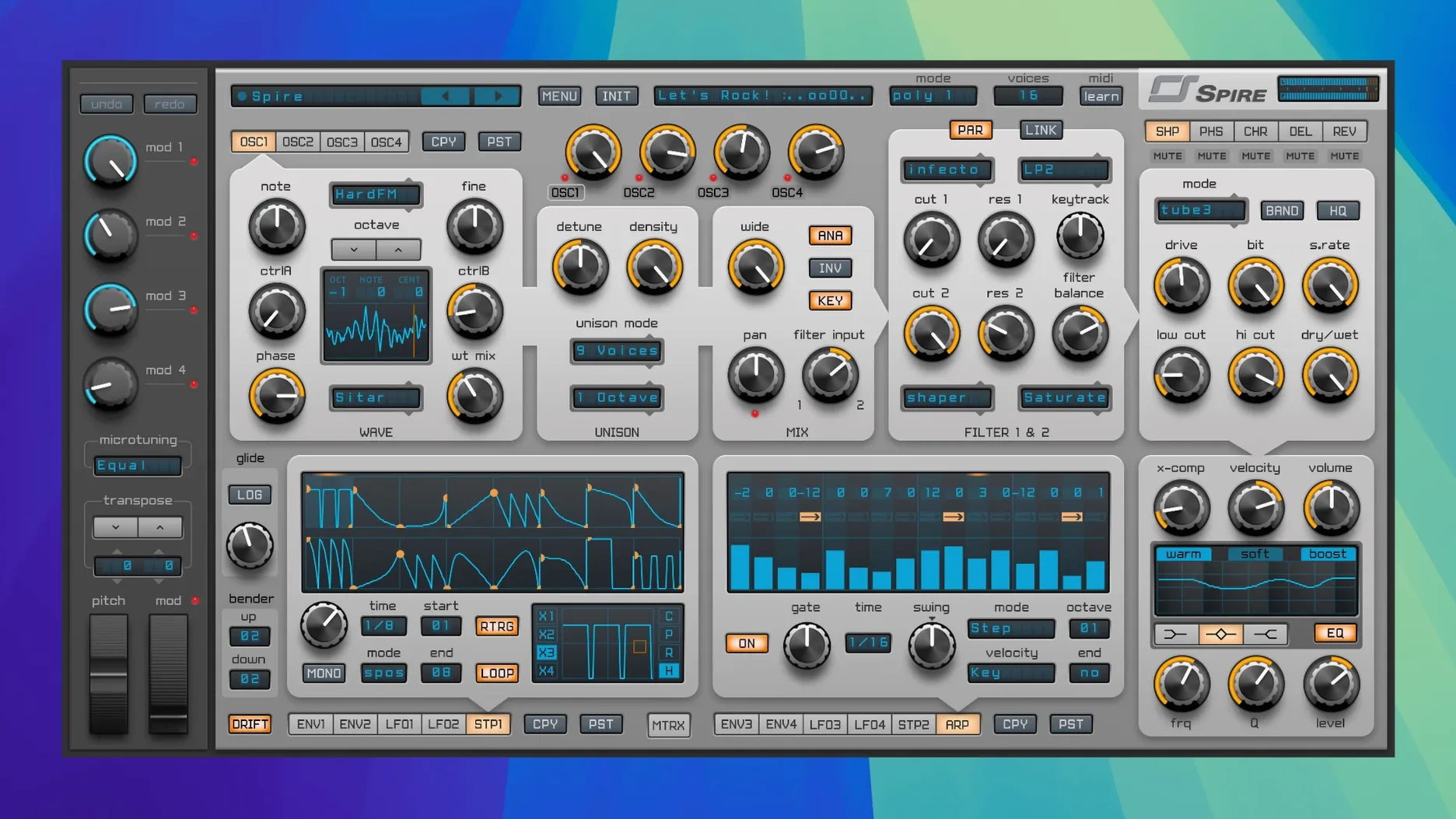
The modulation matrix in Spire is where most of its character lives. You route LFOs, envelopes, and even note velocity to nearly any destination, which makes the difference between a static pad and a moving, breathing one. On a track or bus, it handles leads, basslines, pads, and effects layering without hogging CPU—useful when you’ve got several instances open.
Main synth tracks and bus processing with Spire's effects
- Main synth tracks: leads, basses, plucks, and pads with the 4-oscillator engine, wavetable support, and multimode filter (LP, HP, BP, notch, 12/24 dB slopes).
- Bus processing: send a track to a bus with Spire’s delay, reverb, or phaser for additional movement.
- Sequence-driven parts: the arpeggiator and step sequencer are straightforward to program.
- Quick sound selection: more than 1500 factory and user presets cover most genres.
LFO and ADSR limits plus basic effects to consider
- The 2 LFOs and 2 ADSRs are enough for most patches, but complex modulation-heavy sounds may require layering instances.
- Effects are functional but not deep—distortion and EQ are basic compared to dedicated plugins.
- No multi-out routing in the plugin itself; you’ll route through your DAW’s native channels.
Better DAW and Apple Silicon compatibility in version 1.5.19
Version 1.5.19 (build 5343) arrived in September 2025. Most of the work is under the hood. The most noticeable change on macOS is improved compatibility with newer DAW versions and Apple Silicon hosts running under Rosetta 2 or natively. If you had occasional graphics glitches when the plugin window was resized or when switching between presets quickly, that area was addressed. Preset loading is more reliable with large user banks, something that matters when you have over a thousand factory sounds to browse through.
The update also refined the modulation matrix behavior. Routing an LFO to filter cutoff now responds more predictably when you automate the destination amount, so modulation curves stay in sync across different patch loads. Nothing dramatic, but it removes the need to re-tweak settings after switching presets and returning to your own modulation setup.
Default patch and workflow adjustments to set first
Spire comes with default settings that work for general use, but a few adjustments save time if you start every session with the same workflow:
- Default patch — Spire loads a factory init patch when opened. If you always start from a specific waveform or effect chain, save your own init as the default via the preset menu. That way every new instance starts with your preferred oscillator blend or filter slope.
- Polyphony limit — The default polyphony is generous, but for bass patches with long releases, capping voices at 4 or 6 prevents note-stepping artifacts when playing dense chord voicings.
- MIDI learn — The modulation matrix works faster if you assign your hardware controller’s knobs directly to Spire parameters using the learn function. Assign filter cutoff and resonance to two physical knobs, and you barely need to look at the screen while programming.
Drag-and-drop presets and hidden feature shortcuts
A few features in Spire are not obvious from the main interface, but they help once you know where to find them:
- Drag and drop presets — You can drag a preset from the browser into your DAW’s timeline or a folder to export it as a file. This is useful for sharing patches between machines or storing favorites outside the plugin’s internal database.
- Step sequencer per oscillator — Each oscillator can run its own step sequencer pattern independently. Instead of programming one global sequence, you can layer a rhythmic bass pulse on oscillator 1 and a held pad on oscillator 2, both within the same instance.
- Modulation matrix snapshot — The matrix allows you to copy and paste entire modulation routes between slots. If you create a complex routing for one patch, you can duplicate it to another slot and adjust only the destination, without rebuilding from scratch.
- Preset tagging — The browser supports tags and favorite markers. Marking your go-to bass and lead patches as favorites cuts down browsing time when you need a sound quickly during a session.
Browse factory presets by category for smoother first sessions
Once Spire is installed and activated, a few habits make the first sessions smoother:
- Browse the factory presets by category — Spend twenty minutes going through the Arp, Bass, and Lead folders. Spire’s sound palette is wide, and you will find sounds that work in your genre right away. Noting which preset families you like saves time later.
- Set up your default init patch — After you find a template waveform and filter setup you like, save it as the default. Every new instance will start from that patch, rather than a generic sine wave.
- Test the wavetable oscillator — Oscillator 4 supports wavetable playback. Try dropping a few of the factory wavetables into a sequence and modulating the wavetable position with an LFO. It gives a different character than standard subtractive synthesis and is worth exploring early.
- Save your own user presets — When you tweak a factory preset into something unique, save it to the user bank immediately. It is easy to get carried away and lose the changes when you switch to another patch in the same session.
- Map the arpeggiator to a MIDI keyboard — The arpeggiator is not limited to internal sequences. Play a chord on your controller while the arpeggiator is on, and it will arpeggiate the notes you hold. This makes for quick performance-style entrances without step-by-step programming.
Spire vst crack mac is an illegal copy of a software synthesizer designed for music producers. The activation is handled by MORiA, and the included instructions cover the steps. Focus on the features above rather than installation quirks, and the first days with Spire will be spent making sounds, not troubleshooting.
- Build 5343 for version 1.5.19.
- macOS 10.13 or later
- Intel or Apple Silicon
Questions from the notes
Can Spire run on Apple Silicon Macs?
Yes, Spire 1.5.19 supports both Intel and Apple Silicon architectures natively.
What macOS version is required?
Spire requires macOS 10.13 or later.
Install procedure
- Follow the included installation instructions.
- Follow the included activation instructions.
Reports from players
Sign in or create a tester account to file a report.
No reports filed yet.