
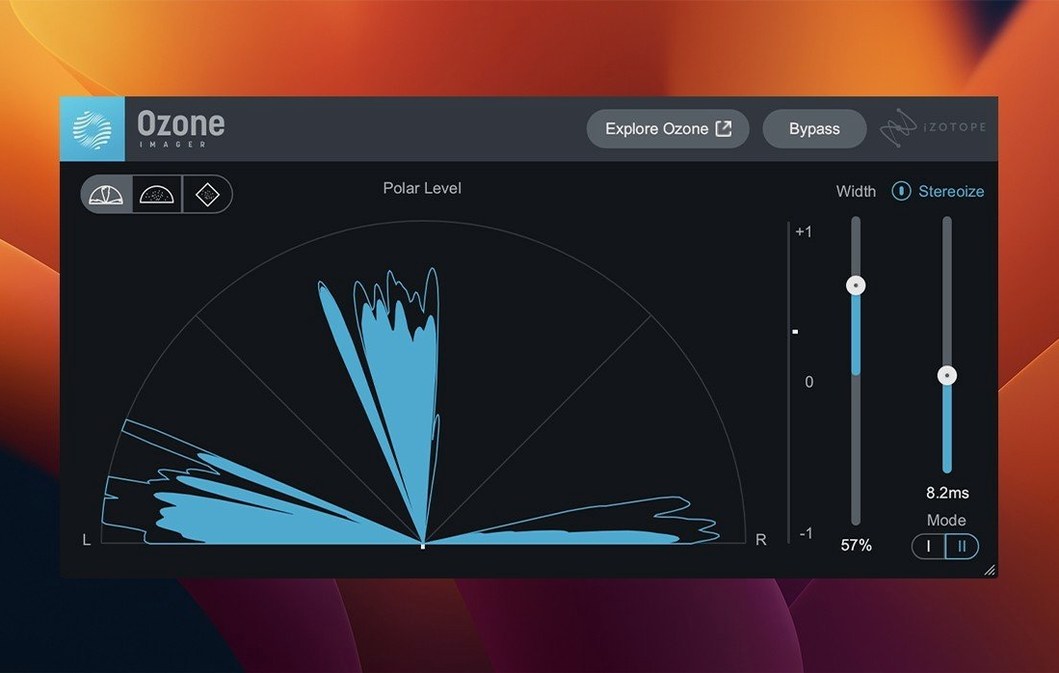
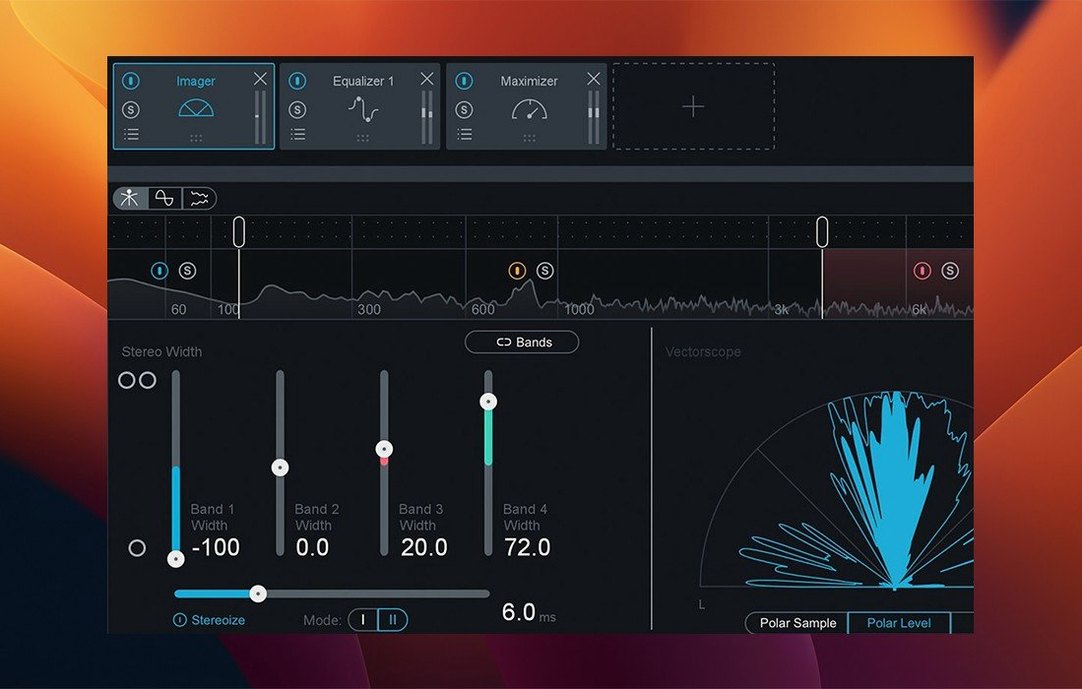
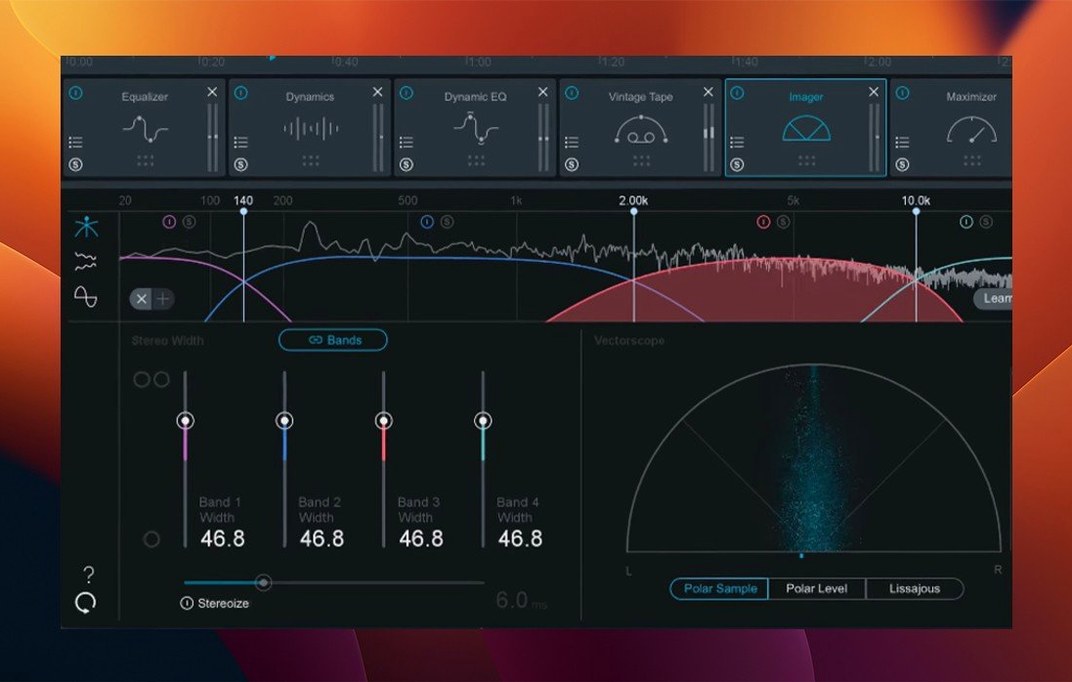
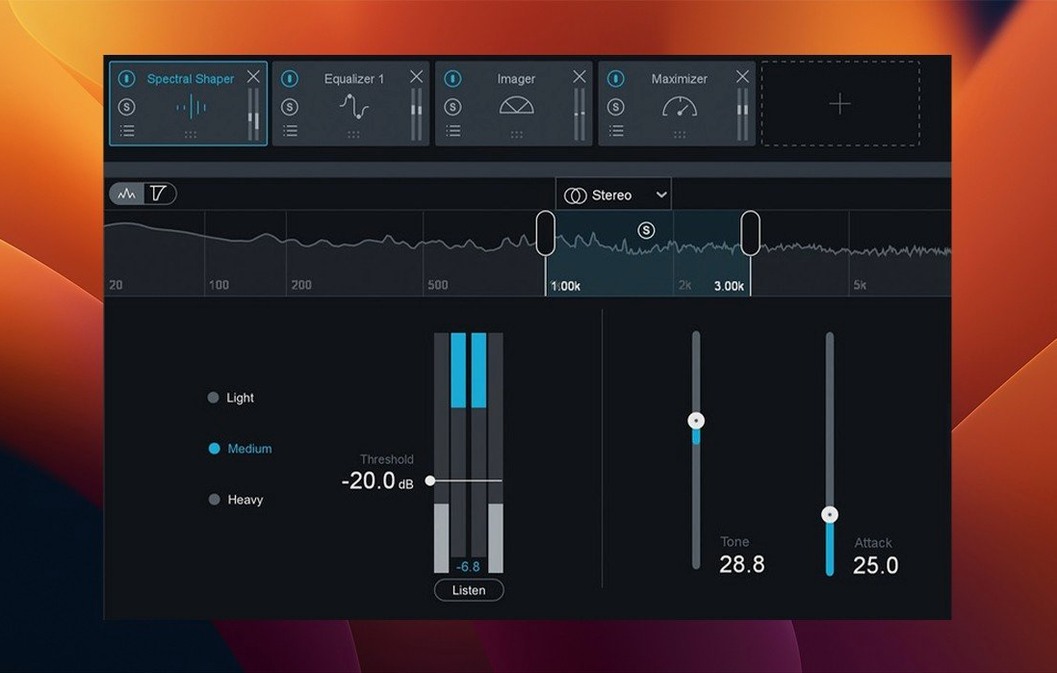
You finish a mix, pull up Ozone as the last insert on your stereo bus, and work through the modules until the loudness and tone sit right. That is the typical session for Ozone: a mastering plugin suite that covers the chain from EQ to limiting without leaving one window.
Version 12.1.0 is the current release, and it is compatible with macOS Ventura 13.7, Sonoma 14.7, and Sequoia 15.4 on both Intel and Apple silicon Macs. The suite includes the Maximizer module with IRC 5 limiting mode, the Unlimiter for transparent peak control, Stem EQ for mid/side and dynamic equalization, and Bass Control to tighten low end. Plugins come in AU, AAX, and VST3 formats, so they slot into Logic, Pro Tools, Ableton, or Cubase without extra wrappers.
This is for people who master their own tracks and want a single toolset rather than a chain of separate plugins. It is also useful if you are working on music for streaming and need a loud, clean master fast. The modules are straightforward to learn, and the presets give a starting point before you adjust anything manually.
iZotope Ozone is a professional audio mastering suite that streamlines final mix polish for music producers and engineers. The update makes the suite feel snappier, which matters when you are tweaking settings across a whole album.
How Ozone fits with other apps and macOS features
Ozone works as a plugin inside any DAW that supports AU, AAX, or VST3 formats. That covers most of what people use on a Mac: Logic Pro, Ableton Live, Pro Tools, Reaper, Cubase 15, Studio One, and Digital Performer. The suite loads as a single insert on your master bus, or you can split modules across multiple tracks if you prefer to build a mastering chain manually.
On macOS, Ozone respects the system audio routing you already have set up. If you use Aggregate Devices in Audio MIDI Setup to combine multiple interfaces, Ozone sees the same output as your DAW. There is no separate audio engine or standalone mode that bypasses the system. The plugin inherits the buffer and sample rate from the host, so you do not have to match settings manually.
For workflow automation, you can save Ozone presets as part of your DAW's track templates. Logic users, for example, can load a mastering track with Ozone already inserted and the Maximizer set to a target loudness. When you bounce a final mix, the DAW processes Ozone in real time or offline, depending on your export settings. Offline bouncing is safe because Ozone is sample-accurate and does not introduce latency beyond what the host reports.
Music producers who mix and master their own tracks
Music producers who mix and master their own tracks will use Ozone the most. If you are a solo artist or a small label engineer working in a home studio, you skip the cost and scheduling of a mastering engineer. Ozone gives you the same essential modules—EQ, compression, limiting, stereo imaging—that a mastering chain would have, with enough control to dial in a specific sound.
Content creators who produce podcast or video soundtracks also benefit, but only if they need loud, consistent output. The Maximizer module with IRC 5 limiting mode is built for that: set a ceiling, set a loudness target, and the plugin adjusts gain reduction to hit it. For spoken-word content, the Stabilizer module can even out tonal shifts across a recording, though it is designed for music first.
Post-production engineers working on film or game audio will find Ozone useful for final bus processing, provided they are comfortable with a mastering-focused tool rather than a mixing plugin. The Unlimiter handles transient peaks transparently, which helps when you need to ride the edge of a loudness spec without distortion. Bass Control is also useful for tightening low frequencies that can build up across a mix.
Collapse modules to focus on one adjustment
When you open Ozone for the first time, a few settings make the experience smoother. The plugin defaults to a relatively complex view with all modules visible. You can collapse individual modules to focus on the one you are adjusting. This does not affect processing, only the display.
The AI-powered assistant is worth trying early. It analyzes your audio and suggests a starting mastering chain based on what it hears. You can accept individual modules or the whole chain, then tweak from there. The assistant is not a set-and-forget tool, but it speeds up the initial setup for someone unfamiliar with mastering.
If you work with mid/side processing, enable the Mid/Side view in the Equalizer or Dynamics module. Ozone shows separate controls for the mid and side channels, which lets you widen a stereo image or clean up center information without affecting the sides. This is also where Stem EQ shines, because it can target specific frequency ranges in mid or side independently.
For loudness targets, set the Maximizer output ceiling to -1 dB or -0.5 dB if you are preparing for streaming. Spotify, Apple Music, and YouTube normalize to different loudness levels, so you can use Ozone's codec preview feature to simulate what your master sounds like after compression. This is not a perfect match for the actual encoder, but it gets you closer than guessing.
Podcast producer uses Ozone for consistent loudness across episodes
Sarah runs a weekly interview podcast. She records guests over Zoom, so the audio comes in at different levels and tonal qualities. She edits in Logic Pro, then applies Ozone on the stereo master to get consistent loudness across episodes.
She uses the Maximizer module with IRC 5 limiting mode, setting the output ceiling to -1 dB and the target loudness to -16 LUFS, which matches her distribution platform's recommendation. The Stabilizer module with a speech preset evens out the tonal differences between her voice and the guest's without making it sound processed. She does not touch Bass Control or the Unlimiter for spoken word. The whole mastering step takes about two minutes per episode, and she exports the final file directly from Logic. Ozone saves her from having to adjust levels track by track.
Insert Ozone on the master bus and bypass all modules to hear the mix
You finish a mix in your DAW and insert Ozone on the master bus. The plugin opens to the main window with the default chain: Equalizer, Dynamics, Maximizer. You bypass all modules and play the mix to hear it without processing.
You click the Assistant button. The plugin analyzes the track for about 20 seconds and suggests a mastering chain. It recommends a gentle EQ shelf, a multiband compressor, and the Maximizer set to a specific loudness target. You accept the chain but disable the compressor because your mix needs less dynamic control.
You adjust the Equalizer first. You pull down a resonant peak at 120 Hz by 2 dB using a bell curve. The Stem EQ mode lets you see if the peak is in the mid channel or the sides. It is in the mid channel, so you leave the sides alone. You also boost 12 kHz by 1 dB on the sides to add air without affecting the center vocal.
Next, you open the Maximizer module. The IRC 5 limiting mode is selected by default. You set the output ceiling to -0.5 dB and the threshold until the gain reduction meter shows 3 dB of reduction on the loudest parts. The loudness target reads -9 LUFS for your genre. You leave it as is.
You toggle the plugin on and off to compare the processed and unprocessed mix. The difference is subtle: the low end is tighter, the high end is clearer, and the overall loudness is more consistent. You save the preset as a template for the rest of the album tracks.
You export the master from your DAW. Ozone processes offline, so the bounce takes the same time as the track length. The resulting file hits the loudness target and fits the format you need for distribution.
iZotope Ozone is a mastering suite that polishes mixes into radio-ready tracks for audio professionals. The assistant and module workflow are the same across versions, but the 12.1.0 update makes the suite load faster and handle mono-to-stereo instances correctly. That matters when you are mastering a project that includes mono samples or stems.
- Fixed slow UI loading and instantiation times.
- Fixed stereo output handling for mono-to-stereo instances.
- Added Cubase 15 to supported host versions.
- Changed supported macOS versions.
- macOS 13.7 or later (Ventura, Sonoma, Sequoia)
- Intel or Apple silicon
- AU, AAX, VST3 (64-bit only)
- Interface: English
Questions from the notes
What Mac models does Ozone 12.1.0 support?
Ozone 12.1.0 runs on both Intel Macs and Apple silicon M-series Macs. It requires macOS 13.7 or later.
What plugin formats does Ozone 12.1.0 come in?
The suite is available as AU, AAX, and VST3 plugins. All formats are 64-bit only.
What are the key modules in Ozone 12.1.0?
It includes the Maximizer with IRC 5 limiting, the Unlimiter, Stem EQ, and Bass Control, covering EQ, dynamics, and loudness in one chain.
Install procedure
- Use the included installation and activation instructions.
- Enter the installation password provided with the release.
Reports from players
Sign in or create a tester account to file a report.
No reports filed yet.