Carbon Copy Cloner 7 is the backup and file copying utility for Mac users who want more control than Time Machine offers. It fits naturally alongside your existing tools: you can clone a whole disk to an external drive, or just copy a folder to a network share when you need it. CCC 7 is a native app on both Intel and Apple Silicon Macs, and Bombich keeps it qualified on the latest macOS, including Golden Gate.
- Choose a destination disk and clone your entire startup volume for a bootable backup.
- Back up specific folders or disks — you decide what gets copied.
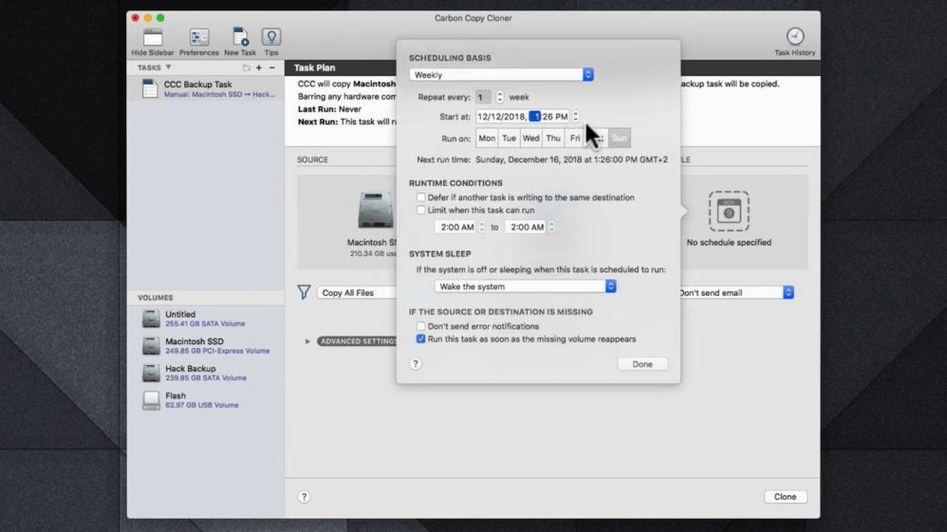
- Schedule backups to run on a chosen day and time, so it works around your routine.
- Run the same tool on any modern Mac, Intel or Apple Silicon.
- Works with the files and permissions you already have, no reformatting required.
For a QA tester, the appeal is simple: it does exactly what you ask, and you can verify the result.
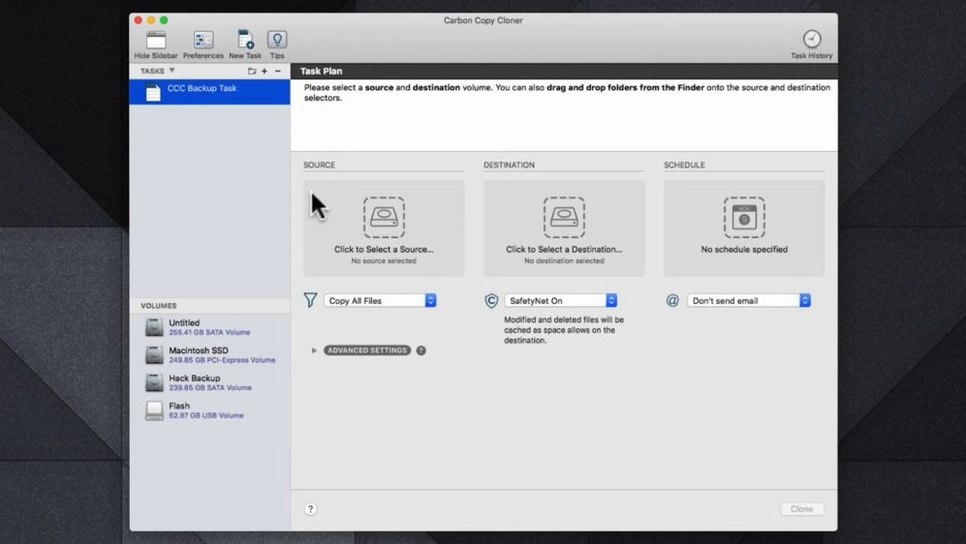
Set up your source and destination in a clean two-panel layout
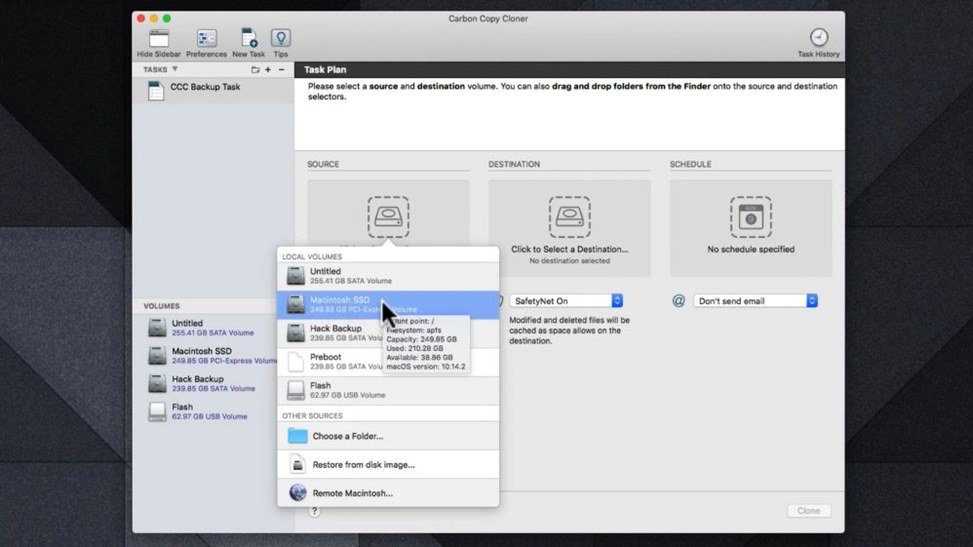
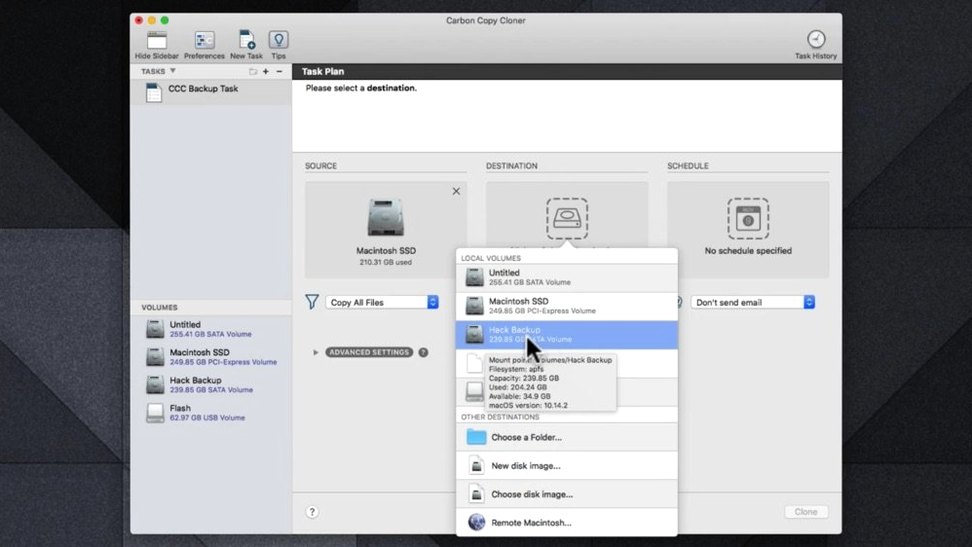
You open CCC 7 and see a clean two-panel layout. The left column lists source volumes — your internal drive, any mounted external disks, network shares. The right column shows destinations. You click your startup drive as the source, then click a connected external USB drive as the destination. In between, the interface draws a line connecting them. Clear enough.
Next, you choose a backup method from a short dropdown. The options are: Clone, File Copy, Incremental File Copy, and Restore. For a weekly full backup of your system, you select Clone. A checkbox lets you include or exclude the EFI system partition — leave it checked if you want the clone to be bootable on the same Mac or a similar one. Uncheck it if you're just archiving the data.
Before running, you can drill into the source volume and exclude specific folders. User Library caches, browser profiles you don't need, Steam game folders you can re-download. CCC respects macOS permissions and file flags, so you do not have to worry about broken symlinks or missing hidden files. You click the Schedule button at the bottom. A popup asks for the day of the week and the time. You set it to Sunday at 2:00 AM, close the window, and the session is done. The backup will run on its own, and you will see a log entry in the morning confirming the bytes copied.
For a one-time file copy, you pick the same source but choose File Copy instead of Clone. The tool copies every file, preserving timestamps and ACLs, but does not make the destination bootable. That is faster for data backups where you do not need a system restore point.
Check compatibility before installing on older macOS versions
Runs on macOS 10.15 Catalina and later
CCC 7 runs on macOS 10.15 Catalina and later. Bombich removed support for older versions like Monterey and Big Sur in CCC 7, so if your machine runs those, you are on the previous major release. The current build is a Universal application, meaning it runs natively on both Intel and Apple Silicon Macs. If you still use Catalina, you are fine. If you are on something older than 10.15, CCC 7 will not launch.
Runs alongside Time Machine without conflict
Not unless you point both at the same destination volume without planning. CCC 7 writes its own backup structure and does not touch Time Machine's snapshot store. You can run both on the same system without conflict. Just make sure your destination disk has enough space for two backup schemes.
Can I restore a CCC clone on a different Mac?
Yes, within reason. A clone of a startup volume created with the EFI partition included will boot on any Mac that matches the source hardware generation. Moving from an Intel Mac to an Apple Silicon Mac is not supported because the firmware layers differ. For file copies rather than clones, the data is cross-platform as long as the filesystem is readable (HFS+, APFS, exFAT, NTFS via third-party drivers).
How does the scheduling work when the Mac is asleep?
CCC 7 uses the macOS wake timer. If you set a backup for 2:00 AM and the Mac is sleeping, the system will wake briefly, run the backup, and go back to sleep. The log will show the wake and sleep events. If the Mac is completely powered off, the job runs the next time you start up and CCC detects the missed schedule.
Best for backup administrators managing multiple Macs
Backup administrators managing multiple Mac workstations benefit the most. You can set a standard clone schedule on each machine, point it to a network share or an external drive, and verify the logs remotely. No client software needed on the destination side. The same applies to IT staff rolling out new machines: clone a configured reference drive, deploy the clone to ten identical Macs, and skip the manual setup step.
Users migrating data to a new Mac also find it straightforward. You clone the old startup volume to an external disk, then connect that disk to the new Mac and use CCC's Restore function to apply the image. The new Mac boots with the same user accounts, applications, and settings. You do not have to reinstall anything except maybe a few hardware-specific drivers if the generation differs.
Home users who want a bootable offline backup without thinking about it every week fit the tool well. Set a schedule, forget about it, and know that if the internal drive fails, you can boot from the clone and keep working.
Real-world scenario: a graphic designer's project archive
A graphic designer works with large InDesign and Photoshop files, plus linked assets stored on an external SSD. The designer wants a nightly backup of just the project folders, not the cache or system files. She opens CCC, selects the external SSD as the source, and navigates into it to check only the "Projects" and "Assets" folders. The destination is a NAS share mounted on the network. She chooses Incremental File Copy so that only changed files are sent each night. After that, each nightly run finishes in under three minutes because only modified .indd and .psd files transfer. The designer never sees the tool again. When a project file becomes corrupted, she opens the NAS share, finds the previous night's version, and copies it back.
Workflow: creating a bootable emergency clone from scratch
Here is the step-by-step for a specific task — making a bootable clone of your internal startup drive to an external SSD, ready to boot in case the internal drive fails.
- Connect the external SSD. Format it as APFS if it is not already. CCC works with APFS and HFS+.
- Open CCC 7. In the source column, select your internal startup volume (usually labeled "Macintosh HD").
- In the destination column, select the external SSD.
- From the backup method list, choose Clone.
- Leave the "Include EFI system partition" checkbox checked. This makes the clone bootable on the same Mac model family.
- If you want to exclude any large folders (Downloads, Movies, Steam), click the source volume to expand it, then uncheck those folders. The clone will still be bootable but will skip those directories.
- Click the Clone button. CCC will ask for confirmation and your admin password. The tool then copies every block, preserving permissions, timestamps, and the file system structure.
- Test the clone: shut down the Mac, hold the Option key (Intel) or the power button (Apple Silicon) during boot, and select the external SSD as the startup disk. The Mac boots into your normal desktop, with everything exactly as it was when the clone started.
- Store the external SSD in a safe place. If the internal drive fails, you boot from the clone and keep working while you replace the internal drive.
Carbon Copy Cloner creates bootable backups for Mac users who need reliable disaster recovery. The tool makes a fully functional offline copy of your system without any special drivers or recovery media. It is the kind of utility you set up once and hope to never use, but when you need it, it is the only thing that matters.
- macOS 10.15 Catalina or later
- Intel or Apple Silicon
Questions from the notes
Can Carbon Copy Cloner 7 create bootable backups?
Yes. CCC 7 can create clones of disks, including the startup volume, which results in a bootable backup on the destination disk.
Does Carbon Copy Cloner 7 work on Apple Silicon Macs?
Yes, CCC 7 is a native application on both Intel and Apple Silicon Macs.
Install procedure
- Install the app by dragging it to your Applications folder.
- Follow the activation instructions included with the download.
Reports from players
Sign in or create a tester account to file a report.
No reports filed yet.