You pull up a low-res portrait shot on a client's phone, crop it, and run it through Topaz Gigapixel AI. The face stays sharp, the fabric texture holds, and the compression artifacts fade. That is the core workflow, and version 1.3.5 handles it on any modern Mac—Apple Silicon or Intel 64-bit, macOS 12 or later.
But the app's real value for an experienced user sits deeper. The neural networks do more than enlarge. They remove pixelation and compression artifacts, and they can restore detail in low-resolution portraits that other upscalers simply blur over. You control the model, the scale, and the output settings, so the tool adapts to the image rather than forcing a one-size-fits-all result.
Topaz Gigapixel AI is the direct successor to the legacy Gigapixel AI line, which ended at version 8.4.4. This version brings the same AI engine to the desktop, with a simpler interface and full support for current Mac hardware. For anyone who has worked with the older builds, the jump is noticeable. The quality is better, and it runs natively on Apple Silicon.
Compared to other Mac upscaling tools, Topaz Gigapixel AI sits in a specific spot. Adobe Photoshop's Preserve Details 2.0 enlargement is decent for small increases, but it tends to introduce artifacts past 2x. Topaz Gigapixel AI handles 4x and beyond better because its neural networks reconstruct texture rather than interpolate pixels. ON1 Resize AI works similarly and supports batch processing on the desktop, but its model selection is more limited and the interface feels busier. Topaz Gigapixel AI gives you fewer clicks to get from import to export, and the portrait restoration model is something neither Photoshop nor ON1 matches directly.
A workflow for restoring a low-resolution portrait from start to finish
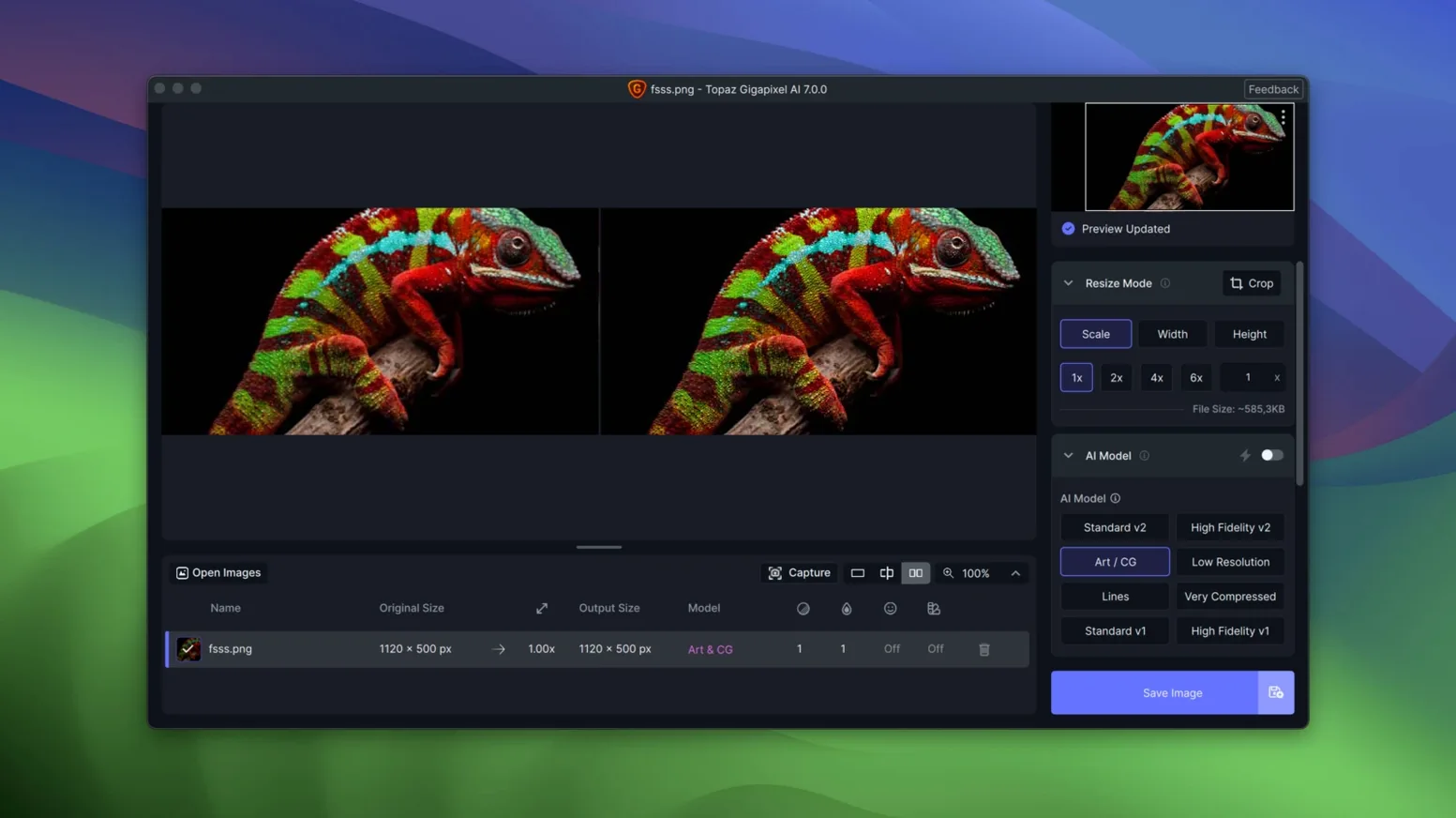
Open Topaz Gigapixel AI. Drag the original JPEG—a 480x640 pixel headshot taken on an old phone—into the app. The preview panel loads the image with the default model. Click the model dropdown and switch to "Face Recovery." This model is tuned for facial features and fabric detail. Set the scale to 4x. The preview area updates in a few seconds, showing the face with visible eyelashes and skin texture that was not there before.
Check the "Remove Compression Artifacts" checkbox. The blockiness around the jawline and hair flattens out. If the image still has noise in the shadows, increase the "Denoise" slider one notch. Do not overdo it—too much denoise wipes out fine hair detail.
When the preview looks right, click "Save." The app prompts for output format and location. For this portrait, pick PNG for maximum quality, or JPEG at quality 95 for a smaller file. The process takes a few seconds per image on Apple Silicon. The result is a 1920x2560 pixel file that looks like it came from a better camera.
Switch to Face Recovery model for portraits not Standard
- Using the wrong model for the image. The default "Standard" model works for general photos but fails on faces. Beginners often skip the model dropdown and wonder why faces look waxy. Switch to "Face Recovery" for portraits, "Line Art" for scans of drawings, and "Low Resolution" for very small images.
- Upscaling too much on the first pass. A 2x or 3x upscale on a small image often looks better than jumping straight to 4x or 6x. Details that the AI cannot reconstruct at extreme scales turn into smears. Do two passes: 2x first, then apply the same model again on the result.
- Ignoring the artifact removal options. The "Remove Compression Artifacts" checkbox and the "Denoise" slider are not cosmetic. They clear the garbage that JPEG compression leaves behind. Without them, the AI upscales artifacts as if they were real detail, making the output look worse than the input.
Upscaling 600x800 product shots to 2400x3200 for print
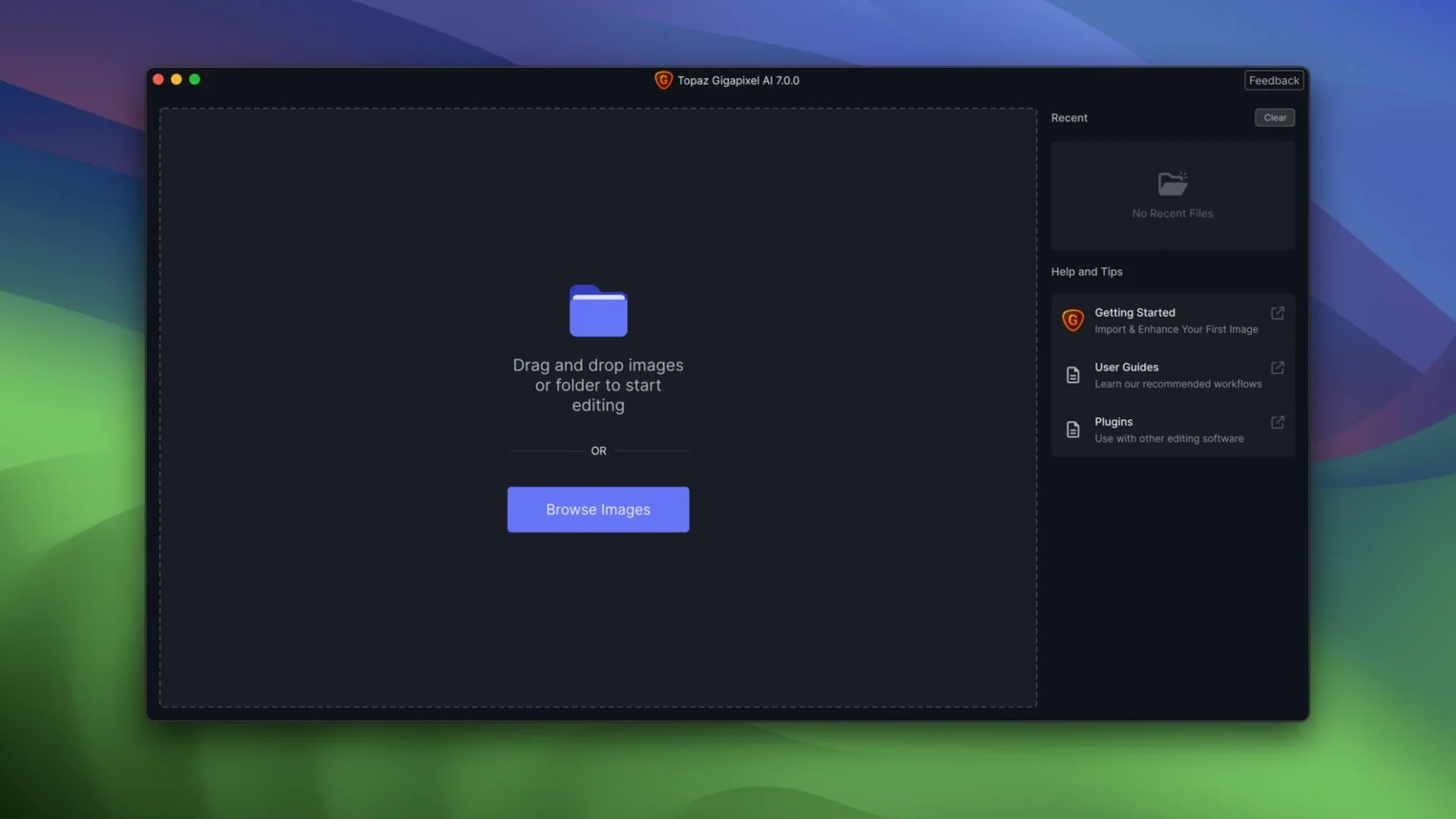
It is a Tuesday afternoon. I have a folder of 600x800 pixel product shots from a client's e-commerce site. The client wants them at 2400x3200 for a print catalog. I launch Topaz Gigapixel AI from the Dock. The main window opens with a file browser. I select all twelve images and drag them into the batch queue. The app shows each image with a thumbnail and a default preview.
I click the first image to set the parameters. Model: "Standard" since these are inanimate objects. Scale: 4x. Artifact removal: on. Denoise: 2. I click "Apply to All" so every image gets the same settings. Then I hit "Start Batch." The progress bar moves from image to image. Each one takes about eight seconds. When the batch finishes, the output folder opens automatically. I scroll through the results. The textures on the fabric swatches look clean, and the product logos are legible. No weird halos, no blur. I rename the files and hand them off.
That is the session. No tweaking per image, no waiting for previews to regenerate after every change. The batch queue and the "Apply to All" button turn a repetitive task into a single click. For mixed batches—portraits and products together—I run two separate batches with the appropriate model. It adds maybe two minutes of setup and saves the headache of switching settings manually per frame.
macOS 12 required with separate ARM and Intel builds
Topaz Gigapixel AI 1.3.5 requires macOS 12 or later. It runs on Apple Silicon and Intel 64-bit Macs. The installation package is split by architecture on the Russian source: one build for ARM and one for Intel. Make sure you download the correct one for your system. The interface is English only, with no language toggle. The package includes activation, so no additional license files are needed after install. The app relies on the GPU for the AI processing. On Apple Silicon machines, it uses the integrated GPU by default. On Intel Macs with discrete GPUs, it should pick them up or fall back to the CPU. The batch processing engine handles multiple files without individual setup once you save a preset. For users searching for Topaz Gigapixel AI Pro 8.4.2 or Topaz Gigapixel AI torrent builds, note that this version is the successor to that line and offers a different interface and processing engine. The legacy Gigapixel AI line ended at 8.4.4, so version 1.3.5 is the current release for modern macOS.
- macOS 12 or newer
- Apple Silicon or Intel 64-bit
Questions from the notes
Does Topaz Gigapixel AI 1.3.5 work on Intel Macs?
Yes, it supports both Apple Silicon and Intel 64-bit Mac computers.
What macOS version do I need?
Version 1.3.5 requires macOS 12 or newer.
Can it restore low-resolution portraits?
Yes, the app can restore low-resolution portraits and remove pixelation and compression artifacts.
Install procedure
- Install the selected architecture package TopazGigapixel.pkg.
- Open Patch.command and enter the Mac password.
Reports from players
Sign in or create a tester account to file a report.
No reports filed yet.