The 2.75 release of Blue Cat's PatchWork is what makes this version worth a look. It added MIDI control for individual plug-in bypass and for opening or closing plug-in interfaces, plus more MIDI event types for parameter automation. There is also a built-in audio recorder that captures up to 16 channels, which turns the host into a usable multi-track capture tool without leaving your session.
Formats and compatibility come first here, because that is the point of a patchbay. The macOS build runs on both Intel and Apple Silicon, 64-bit only, and works with macOS 10.9 and later. It loads third-party VST and VST3 plug-ins, and it supports AUv3 format on macOS. A plug-ins browser with search and a scanner keep large collections manageable, and presets save the whole chain.
- Loads VST, VST3, and AUv3 plug-ins inside any host
- MIDI-mappable bypass and interface open/close per plug-in
- Built-in 16-channel audio recorder
- Searchable plug-ins browser and scanner
- Drag-and-drop installation for plug-in UIs
- 64-bit only, Intel and Apple Silicon, macOS 10.9+
One limitation to know: on macOS, VST3 editors load only when the interface is actually visible. The sound is whatever you chain through it — PatchWork does not color audio, it just routes it. For mixing several plug-ins in series or parallel, it behaves like a rack that fits inside your DAW.
Full-text search across saved plug-ins
The presets browser does full-text search across saved plug-ins, not just names. Type part of a parameter value or a plug-in manufacturer and matching presets appear as you type, no waiting for a search index to build. This is useful when you remember a specific reverb tail time but not which preset name you saved it under.
The built-in plug-in scanner is not just a one-time setup tool. Run it again after installing new third-party plug-ins, and it updates the browser without restarting PatchWork or your DAW. The scanner respects the standard VST and VST3 plug-in paths macOS uses, but it also picks up plug-ins from custom folders if you place them there.
Copy, paste, save, and reload for effects chains were added in 2.75. This means you can build a processing chain in one instance, copy it, and paste it into another PatchWork instance in a different project. The save and reload functions let you store a chain as a file and bring it back later, no need to re-patch everything from scratch.
Standalone or DAW plug-in for routing and recording
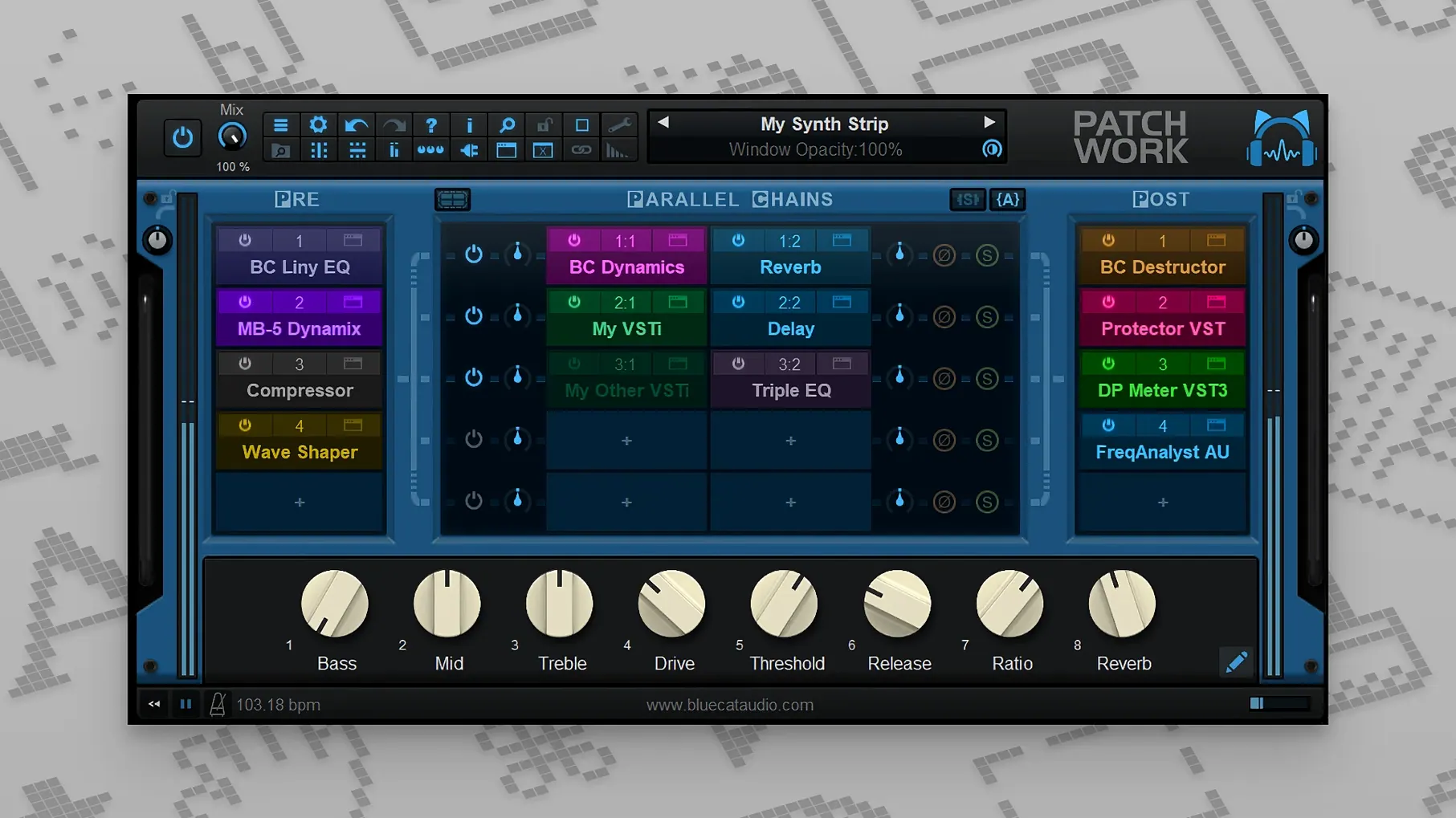
PatchWork works as a standalone application or as a plug-in inside your DAW. As a standalone host, it loads VST and VST3 instruments and effects, routes them in series or parallel, and records the output. This is useful for live performance setups where you want to run multiple plug-ins without opening a full DAW.
Inside a DAW, PatchWork appears as a single plug-in instance that can host up to 64 sub-plug-ins. This reduces track count and keeps your mixer tidy: one track, one plug-in slot, sixty-four processors inside. The sub-plug-ins handle all the audio routing, and the DAW only sees PatchWork's input and output.
On macOS, drag-and-drop installation from the file system works for plug-in user interfaces. You can drag a plug-in bundle from Finder directly onto PatchWork's window, and it loads the plug-in without going through the scanner first. This is faster for one-off plug-ins you do not want to add to the permanent browser.
The AUv3 support is specific to macOS. If you have older Audio Unit plug-ins that use the previous AU format, they are not compatible — only AUv3 works. The VST3 editor loading limitation is also macOS-specific: the editor only loads when the interface is shown. VST2 editors do not have this limitation.
64-bit only, missing plug-ins need a rescan
- Plug-in not showing up in the browser. Run the scanner again. If the plug-in still does not appear, check whether it is 64-bit — PatchWork is 64-bit only and does not load 32-bit plug-ins. Also confirm the plug-in uses a supported format (VST, VST3, or AUv3).
- VST3 editor does not appear. On macOS, VST3 editors only load when the plug-in interface is visible, not in the background. Make sure the plug-in window is open and focused. This is a known limitation of the current version.
- MIDI mapping not responding. MIDI control for individual plug-in bypass and UI open/close was added in 2.75. If your version is earlier, these parameters will not be available. Check the version number under About in the menu. Also verify that MIDI input is enabled in PatchWork's preferences and that your DAW is sending MIDI to the correct track or instance.
- Audio recorder shows no input. The recorder captures up to 16 channels, but it records the post-fader output of your chain. If your routing is parallel, make sure each parallel path is assigned to a distinct output channel — otherwise the recorder may see silence on unused channels.
- Installer blocked on macOS Catalina or later. If the computer is offline, macOS may refuse to open the PKG installer from the DMG. Open the installer from the context menu (right-click and select Open) instead of double-clicking. This bypasses the online verification step.
- Added MIDI control for individual plug-in bypass and interface open/close actions
- Added more MIDI event types for parameter control
- Added a built-in audio recorder supporting up to 16 channels
- macOS 10.9 or later
- 64-bit processor (Intel or Apple Silicon)
- English interface
Questions from the notes
Can Blue Cat PatchWork load AU plug-ins?
The macOS version supports AUv3 format plug-ins. Classic AU (Audio Unit) format is not listed among the supported third-party formats.
Install procedure
- Open the downloaded DMG file.
- Run the PKG installer inside.
- On Catalina or later, if macOS blocks the installer and the computer is offline, right-click the installer and choose Open from the context menu.
Reports from players
Sign in or create a tester account to file a report.
No reports filed yet.