
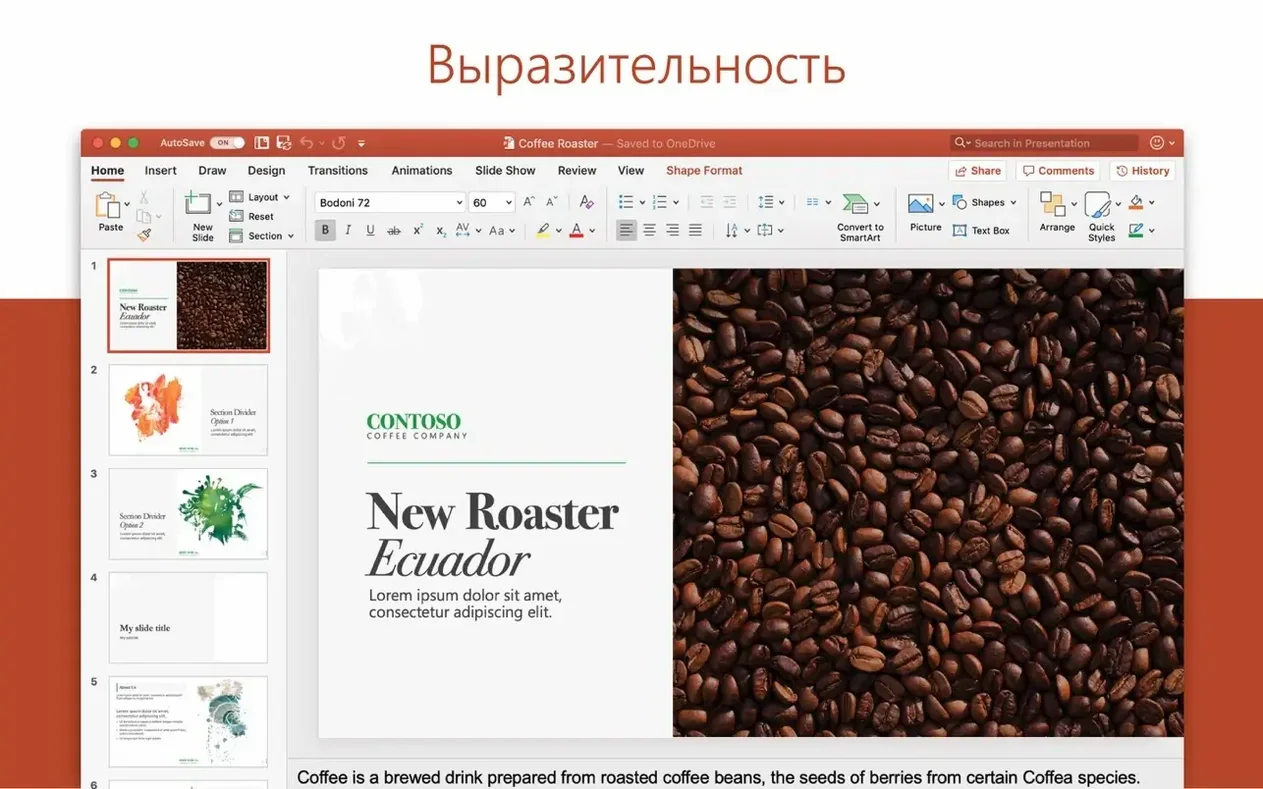
Anyone who needs to build slides for meetings, classes, or pitches will find PowerPoint for Mac familiar and capable. Here are the first things a newcomer should try.
Layout tools
Slide Master — a single view where you edit fonts, colors, and placeholders across every slide at once. Saves time when you need a consistent look without tweaking each slide individually.
Animation basics
Motion paths — drag a red dot to set where an element moves. Start with simple paths (line, arc) before combining multiple ones.
Visuals that work
3D models — insert a model from the built-in library and rotate it live during a presentation. Adds depth without needing external software.
Icons — scalable vector icons bundled in the app. Drop one on a slide, change its fill color, and it stays sharp at any size.
New users often run into the same few snags that are easy to fix once you know where to look. Here is what I see most and how to sort them out.
Slide Master fixes paste glitches and font mismatches
Fonts look different on another Mac
You build a slide deck using a font you downloaded. You send the file to a colleague, and the text shifts or wraps oddly. PowerPoint for Mac does not embed fonts by default. The fix is to convert the text to outlines before sharing — or stick to system fonts (Arial, Calibri, Helvetica) if you know the file will move between machines.
Animation timing slides off in playback
You set an object to fade in over half a second, but in slideshow mode it either skips or hangs. This usually happens when you stack too many animations on a single slide or combine entrance and motion-path effects on the same element. Reduce the count: one animation per logical step, and test in slideshow mode, not the editing pane.
3D model rotation stops responding
You insert a 3D model from the library. In edit mode you can rotate it freely, but during a presentation the rotation tool disappears. PowerPoint for Mac treats 3D models as static during slideshow unless you enable the action button for it. Right-click the model in the editing view, select the rotate option, and confirm it is set to "interactive."
Slide Master changes do not apply to all slides
You edit the title placeholder in Slide Master, but half the slides still show the old formatting. This means those slides use a different layout or have manually overridden text boxes. Switch each slide to the correct layout via the Home tab, or delete the overridden text box and insert a fresh one from the layout.
Version 16.93 shifts how you open and save files
Version 16.93 is part of the Office LTSC Standard for Mac 2024 release. The changes are not dramatic — no redesigned interface or new file format — but a few things shift how you work day to day:
- Open and save times for presentations with embedded 3D models and high-resolution images are slightly faster than in the previous LTSC release. The app loads the slide thumbnails sooner when you scroll through the left pane.
- Motion path previews now show the full trajectory before you commit. In earlier versions you had to guess where the path would go by dragging the red dot blind. Now a faint dotted line appears as you move the dot.
- Icon search in the Insert tab now returns results as you type, rather than requiring a full word and a press of Enter. The list updates each keystroke.
- Animation pane scrolling is smoother when you have more than a dozen animations on a single slide. The list no longer stutters as you drag effects to reorder them.
None of these changes break existing workflows. They mainly remove friction from operations that were slightly sluggish before.
Real-world scenario: a student preparing a group presentation
A second-year university student needs to prepare a 15-minute presentation on urban water management. She has the core research done — graphs from Excel, a few photos, a short video clip. She opens PowerPoint for Mac on her personal Mac, starts from a blank presentation, and sets up the Slide Master with her school's colors and a consistent heading font.
She pastes the graphs directly from Excel. The data updates automatically if she changes the source file, which matters because her lab partner is still tweaking numbers. She inserts a motion path on a diagram of a water treatment cycle — arrows that follow the flow from intake to discharge — and tests it a few times until the timing matches her spoken pace. The video clip goes in as an embedded file, not a link, so it still plays when she presents from a different laptop in the lecture hall. She exports to PDF for backup, then sends the .pptx to her group via OneDrive.
Set defaults once in Slide Master before adding slides
These save time without requiring any setup wizards or configuration panels.
- Open Slide Master first, not a blank slide. Set your default fonts, background color, and footer position once. Every new slide you add afterward inherits those settings.
- Use the icon search instead of hunting through folders. Type "arrow" or "check" in the Insert > Icons field. The vector icons are resolution-independent and look cleaner than most free clip art.
- Save a copy of your file before adding 3D models. If you rotate the model extensively during editing, the undo history can grow large and slow down saves. A fresh copy keeps the file lean.
- Test your animations in slideshow mode after every five slides. The editing view does not always show the exact timing. Catching a misaligned motion path early beats redoing a whole segment later.
- Set the default save location to OneDrive if you switch between devices. PowerPoint for Mac remembers the last folder you used, so point it to a cloud folder once and it stays there.
Start with a blank file, then build slide by slide
This is what a session looks like when I build a presentation from scratch — no frills, just the sequence that gets the work done.
I open PowerPoint for Mac. The start screen shows recent files and a blank option. I click blank. The interface is mostly empty — a single title slide with two placeholders. I delete the title slide and go straight to Slide Master mode. I set the default font to something clean (Calibri), the body text size to 18 points, and the background to a dark gray. I close the master view. Every new slide I add now uses those settings.
I add a title slide with the presentation name and my name. I insert a few icons from the built-in library — a gear for process, a person for team, a chart icon for data. Each one scales to fit the placeholder without losing sharpness.
I paste in the body text from a Word document. The text flows into the placeholders. I adjust the line spacing and add bullet points where the structure needs hierarchy. I do not touch the font size; the master already set it.
I insert a 3D model of a building structure from the Insert tab. The model appears on the slide. I rotate it to show the side view. A faint dotted path shows the rotation arc as I drag. I leave it static — no animation — because the model speaks for itself.
I add a simple motion path to an arrow pointing at a graph. The arrow starts off-screen, slides in from the left, and stops next to the graph. I preview it in slideshow mode. I preview again. It looks right.
I save the file to a local folder, then copy it to OneDrive for backup. The interface stays responsive throughout, even with the 3D model and a few icons on the same slide.
- Office suite release 16.93 includes PowerPoint.
- macOS 13 or later
- Apple Silicon or Intel 64-bit processor
Questions from the notes
Does PowerPoint for Mac work on Apple Silicon?
Yes, PowerPoint supports both Apple silicon and Intel 64-bit architecture on macOS 13 and later.
What interface languages are available?
PowerPoint for Mac includes 21 languages: English, French, German, Spanish, Italian, Japanese, Korean, Russian, and others.
How do I activate the installed version?
Install Microsoft Office LTSC 2024 VL Serializer after installing the Office package to activate PowerPoint.
Install procedure
- Install the standard Office 2024 package.
- Or download the required package using the provided links for Word, Excel, PowerPoint, Outlook, and OneNote.
- All packages are downloaded from official Microsoft servers and require activation.
- To activate, install Microsoft Office LTSC 2024 VL Serializer.
- To receive updates, install Microsoft AutoUpdate (MAU).
Reports from players
Sign in or create a tester account to file a report.
No reports filed yet.