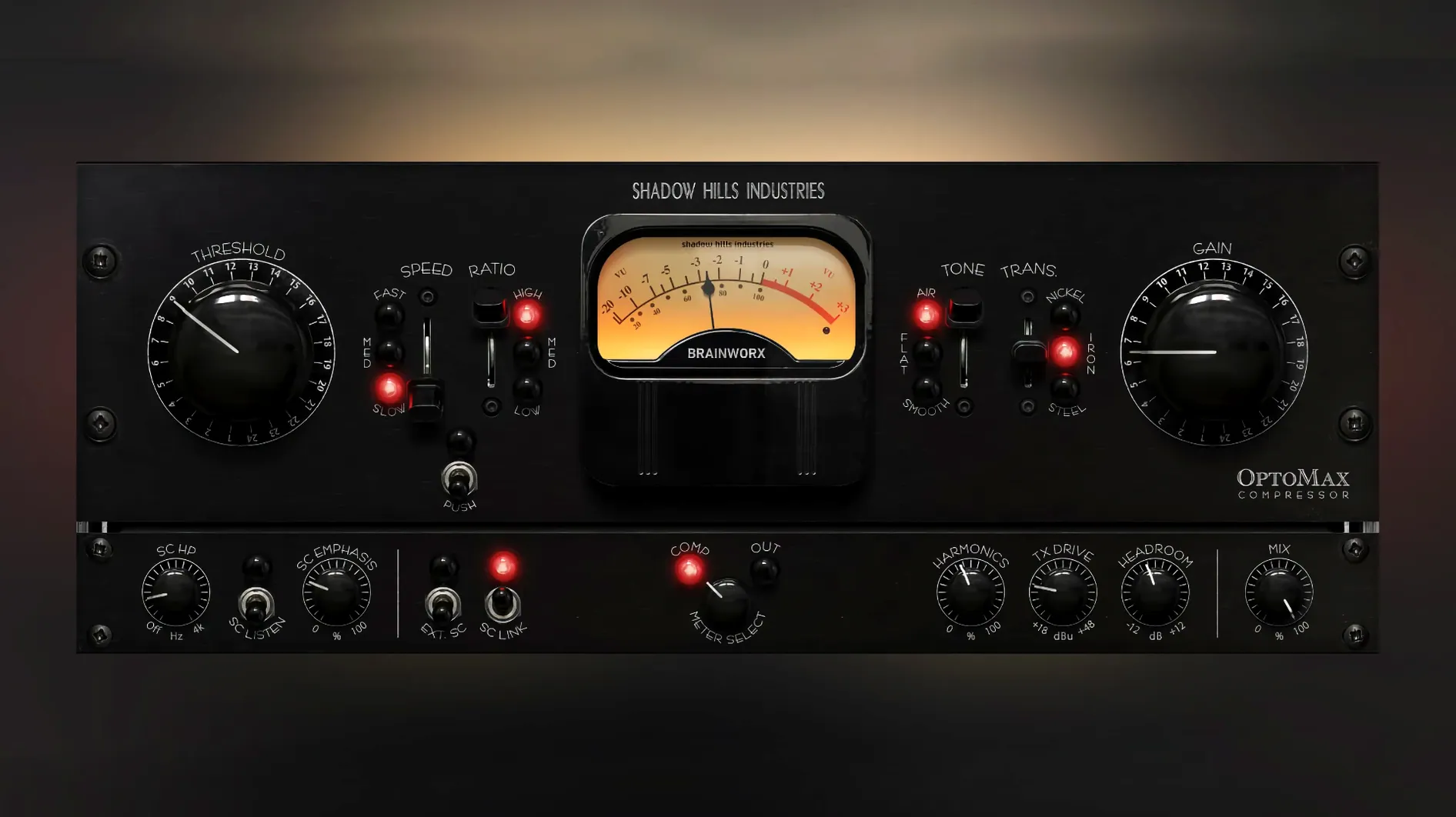
Runs on any Mac with macOS 12 or later, Intel or Apple Silicon. This is the optical section of the Shadow Hills Mastering Compressor, recreated as a plugin.
Controls and what they do
Response modes — slow, medium, and fast settings for how quickly the compressor reacts. Slow preserves more of the original dynamics; fast catches peaks harder.
Shine — a high-frequency mode that adds air and presence without pushing the mids.
Softness — the opposite: tames harsh highs, useful for bright sources.
Transformer types — nickel, iron, and steel. Each colors the signal differently, from smooth to punchy.
Parallel mix — blends the compressed and dry signals, so you can keep transients while still evening out levels.
Loads directly into any major DAW
The OptoMax works as a standard Audio Units, VST, or AAX plugin, so it loads directly into Logic Pro, Ableton Live, Pro Tools, Reaper, Cubase, or any other DAW that supports those formats. No wrapper or extra software is needed — the installer places the plugin files into the correct system folders automatically.
Because it's an optical compressor, it pairs well with other dynamics processors. A common chain is to use a fast digital compressor first to catch transients, then let the OptoMax handle the overall leveling with its slower response. The built-in parallel mix control means you don't need to set up separate busses for compression blends — it's done inside the plugin.
On the master bus, the transformer types become a subtle tone-shaping tool. Nickel keeps things clean for classical or acoustic material; iron adds weight for rock and electronic; steel sits in between, useful for pop and hip-hop. The Shine and Softness knobs let you adjust the high end without reaching for an EQ, which saves an insert slot.
Drag-and-drop installation with no wrapper needed
Installation is a standard drag-and-drop or installer-package process, depending on how Plugin Alliance distributes their plugins. After downloading, you mount the disk image and run the installer. The plugin appears in your DAW's plugin manager after a fresh scan.
System requirements are macOS 12 or newer, with both Intel and Apple Silicon supported natively. No Rosetta translation is needed on Apple Silicon Macs — the plugin runs as a native ARM binary. The interface scales well on Retina displays, and the controls respond without noticeable lag.
Disk space is minimal — this is a single plugin, not a sample library. Expect a few hundred megabytes at most for the installer and plugin files. CPU usage depends on how many instances you run, but optical compressor algorithms are generally lighter than convolution reverbs or spectral processors.
Works on individual tracks and mastering buses
Can I use this on individual tracks, or is it only for mastering?
It works on both. The optical section was originally part of a mastering compressor, but the response modes let you adjust it for busier sources. On vocals, the slow mode with a touch of nickel transformer gives a smooth, natural level. On drum buses, the fast mode catches peaks while the parallel mix preserves the attack.
Does it require an iLok or internet connection?
The version distributed on this site is pre-activated — no iLok, no license file, no online authorization. You install it and it works.
What if my DAW doesn't see it after installation?
Restart your DAW and rescan plugins. If it still doesn't appear, check that the installer placed the files in the correct component or VST folder. On macOS, Audio Units go in /Library/Audio/Plug-Ins/Components, VST3 in /Library/Audio/Plug-Ins/VST3, and AAX in /Library/Application Support/Avid/Audio/Plug-Ins. If the installer handled everything correctly, a manual rescan usually fixes it.
Start on medium response with 3-5 dB of reduction
Start with the response set to medium — it's a safe middle ground that works on most material. Dial in 3-5 dB of gain reduction, then cycle through the three transformers to hear how the tone changes. Iron will be noticeably thicker; steel is a good reference point.
Try the Shine knob on a dull vocal or acoustic guitar track. On bright sources like hi-hats or cymbals, the Softness mode tames the top end without making it sound muffled.
Use the parallel mix to dial in the compression depth. This gives you the leveling without losing the original transients.
For master bus work, avoid hard limiting with the fast response — the optical character is more about gentle control. Slow mode with nickel transformer and a low ratio keeps the mix sounding open while preventing peaks from jumping out. If you need stronger peak control, add a separate limiter after the OptoMax.
Version 1.0.0 is the initial release. The developer lists 1.0.1, which fixes a gain reduction meter issue in Pro Tools.
- Initial release of the optical compressor plugin.
- macOS 12 or later
- Intel or Apple Silicon
Questions from the notes
Does the plugin work on Apple Silicon Macs?
Yes, it supports both Intel and Apple Silicon architectures, as long as you're on macOS 12 or newer.
What are the three transformer types for?
Nickel, iron, and steel each add a different harmonic character. Nickel is smoother, iron is rounder, steel is brighter and punchier.
Install procedure
- Open the downloaded disk image.
- Run the installer.
- Follow the on-screen prompts.
Reports from players
Sign in or create a tester account to file a report.
No reports filed yet.